Saturday, October 22, 2022

8 Magic Songs

[1] Bourree of the Bastard
This song is played at a frantic pace; best played on drums made of human skin or a decaying violin that shrieks. Anyone who hears this song begins to feel both rage and a sensation of revelry at the same time; a sort of casual violence and cruelty overcomes the listener; no morale checks are rolled for those who can hear this song.

[2] Song of the Skyless
This magic song is special to those who have spent their entire lives underground. To anyone who has ever seen or lived on the surface world; the song sounds sort of tinny and wrong, but to those who have only known the underdark or subterranean places, this song is enrapturing. If you play this song to a being who has only ever spent their life underground; treat your reaction check as the highest possible result for this creature. For unintelligent creatures, the song is simply a pleasant noise, so only treat reaction checks rolls as a +1 for the pleasing melody.

What creatures have spent their whole life underground? Dwarves (except nobility) have a 1 in 10 chance to have never gone to the surface. Orcs, Drow, Gnolls, and other cave dwelling races only on a 1 in 4 since they frequently raid the surface world. If creatures are in a group together- assume the ones who can hear the song get the best reaction check but the rest go along as normal- treating your song as some kind of enchanting witch spell instead of a special song just for them.

[3] Melody of Mold
Low, ambient sound usually enchanted on old stone, or more rarely, plays softly from clusters of glowing mushrooms deep underground. Every mushroom, growth, mold, or myconid near the sound becomes resistant to fire- fields of sporecaps are protected by their own natural melodies. Fire only has a 1 in 6 chance to spread when you try to light a room full of shrooms. Blowing them up doesn't work much better- they'll hide underground before popping back up again undamaged. Clouds of spores or pollens are not protected by this spell, so you may be able to clear a safe path through a toxic mushroom swamp by burning the clouds away and giving yourself a brief window to pass.

This sound is considered to be a natural phenomena. Some say it's the closest things that mushrooms have to a God- a sort of proto-creation of natural harmony and cooperation joined together.

[4] Song in a Shoe
This song can be played on any instrument, but always appears as a pair of silver shoes with a unique flair or in the style of the player of the song. These shoes grant fleetness of foot- a traveling speed increase of one sixth or one extra hex per day of travel, and those who wear these shoes are never surprised- but the shoes give off the song with each and every step the wearer makes, making stealth impossible and clearly showing the wearer is under the effect of a spell unless if they have instruments they can pretend to play to cover up the sound of the song.

The Song in a Shoe keeps working for one full day or until the wearer stops walking for more then a turn (going into a dungeon, traveling by boat, riding a mount, or making camp stops this spell).

[5] Ragtime Rites
Fast paced, engaging song played by a group. While most funerals are quiet, mournful affairs, this song is more upbeat and energetic. It has the effect of calming and weakening restless spirits- causing the undead to return to their eternal rest after a bout of spirited dancing. Violent undead, however, will still attack. Each round the song is played, all undead nearby will dance, with restless and evil undead or servants of necromancers taking 1 damage per round until destroyed.

This song is a specialty of the Merrymarrows, who do not take any damage from the song, but it helps get their old bones moving. It is for this reason that the lands they hail from have such colorful funerals; it's an excuse for the skeletons to party while putting down actually dangerous undead.

[6] Goblin Song
This son is performed most commonly by goblins in a goblin war band- which is basically just what happens when more then a dozen goblins get together and get bored of messing with each other. Sounds suspiciously like the Melody of Mold just with scratching goblin singing over it- considering the melody is the goblin's second favorite song they probably just copied it. It has a similar effect, except it applies to all goblins in earshot, who gain +2 temporary Hit-Points.

Whenever this song is played; no actual instruments are needed, just various objects to smash together, bones to clatter, or the occasional cat that they stick pins in to make an instrument.

[7] Lawful Litany
Imbued with the powers of Law, this alignment-based song has a holy sound. If this song is playing, any lawful cleric will Turn Undead as though one level higher. In addition, unholy noise, demonic chants, and spoken curses will fall dead in the throats of the sinners; cancelling or silencing the spells of those of Chaotic alignment.

The twinkling highs and harmonious voice of this song are truly beautiful to hear. It is said that this song is a copy of a copy of a memory of a dream of a holy man once allowed to hear one single song in heaven.

[8] Rhetorical Requiem
Only the name of this song is known to people- the words and how it goes is not. This song is not remembered by anyone who hears it- only those who know how to play. While the song itself is moving, immediately after it is played, all who heard it forget its details and the performance. The subjects of this spell lose all memory of the performance itself; just that they "heard" the song. This also applies to anything said or heard during the song as well- which fades into its performance. You could accuse someone of murder with its lyrics, see their horrified reaction at being found out, and then when the song ends they forgot you ever accused them of anything.

This song has been used by many to fleece patrons, to investigate rumors, to trick and confuse. But be warned, those who cannot hear the notes being played will remember everything they have seen and felt. This is the reason why the wise always keep a deaf man with them when they hear the strings play.

Tuesday, October 18, 2022

Vagueposting- The Static Dynamic

In the classic Silent Hill 2, there is a part that happens involving this chap where the player is knocked off a high place. When you hit the ground, you are automatically knocked to critical health from whatever health value you are at from before this encounter. Since it's basically required to have this encounter on a playthrough, since it gives you access to a new area, it's something everyone who plays the game will go through.

Isn't that interesting?

Think about it. This is a survival horror game, with limited resources for things like ammo and healing items, with a moment where the player is forced to take damage. This is especially important in Silent Hill 2 as one of the game's endings can be influenced by having taken a lot of damage. There is someone, somewhere, in the world who got the aforementioned ending because of this event- they just happened to be low on healing items when this event happened. Somebody else probably died to a monster afterwards because of the damage; or others had to expend a healing item that would have come in handy at a later portion. While interacting directly with the gameplay, this moment is a scripted event in a story that cannot be changed. This also is not a quicktime event or test of reflexes or planning, since it's something that will always happen that you have no imput or control over.

I think there is a really interesting overlap between these two different worlds of a game; the "game and the story" being normally separate entities, but instead being put together. It's uncommon for a game to actually waste the players ammo in a cutscene where they shoot their weapon, for example, and rare for damage in a cutscene to carry over either. What does this say about the game if it does happen?

Definitions
The title of this post is a bit of an oxymoron.

When it comes to games, be them tabletop or of the video variety, there is a gradient between static and dynamic. Dynamic games would be games with more interactive, random, or changing gameplay elements that add more factors to any individual play session, where as a game more on the "static" side would be the opposite. More scripted, cinematic, or on-rails for a tabletop descriptor. Something at the absolute end of the "static" side would probably be something like a Choose-Your-Own-Adventure book, where as the most dynamic possible would be a traditional game of D&D or something similar with a new adventure created on the fly by the dungeon master or players every session.

In the most static game imaginable, you might have multiple encounters with a monster or forced resource "checks" where the player loses some kind of counter or resource in scripted sequences. Some concepts like this already exist in tabletop games; such as needing one ration of food per day when away from civilization. This is a mandatory resource that can't be overcome with good rolls (except for maybe a Survival check, but it's not the same as health- you don't lose health every day and only need to use healing potions if you get a bad roll or make a mistake). 

In a game like this, everything or anything that happens could be set in stone and you are simply following along; like literally playing out a movie or a book, scene by scene, needing to make the various checks and expend resources at the right moments. Now I think most people would find a game like this very boring and somewhat pointless, myself included, but in my opinion, the concept of a game with scripted or set "moments" like this is an interesting idea space.

Consider a campaign where the players psychic or cyberpunk brain-to-computer hackerman by the rules lose a certain amount of health/sanity/magic points whenever they use their abilities. However, it is well established early on in this campaign that you must unlock the three computer terminals or mind-control the three lieutenants; thus creating a sort of anticipation and phase of preparation for that player. Because there is a set, established set of things that the player(s) must preform, this scripted "story" sequence becomes part of the game. In anticipation for this checkpoint, you can't expend too many of your magic points or else you'll have to roll on the psychic backlash table or what have you. And after the event, some of your resources are gone without being totally up to the player to decide how to use them.

Also, it should be noted here that a "scripted" or "set in stone" event may or may not even exist in the perception of the one experiencing it. You wouldn't be able to tell if everything that happens in your game was the result of rolls on a random table or predetermined- save for those things that don't flow logically or are thrust upon the players ala a railroad.

Unique Encounters
What exactly is the place of a scripted event or railroaded event in a game or sequence? Most consider it a result of poor GM/DM/QM decision making. I also agree that these are not as fun or interesting in tabletop games then they would be in a video game.

Another example of a similar concept are unique and specific encounters in a game; such as boss fights or enemies that are only fought once or with a specific gimmick. This to me is an interesting idea space; the idea of an otherwise free flowing "game" state that interacts with a set encounter. Tabletop games are rife with this sort of thing for obvious reasons; an encounter with bandits but the bandit leader has a magic weapon or a sorcerer that casts a specific spell, etc. However I consider this more on the dynamic side of this made up spectrum. In the world of video games however, we see something like this much more often, possibly because most of the gameplay is already relatively "static" in how the player can interact with the game world in such a way.

For example; in most games there may be a few generic enemy types. Zombies, zombie dogs, giant spiders, etc. Typically you'll encounter each of these separately in different arrangements. Zombie dogs fought in a hallway is different then zombie dogs fought out in an open field. You can manage one zombie easily but three or more is a hoard that you might find it hard to escape from, etc. If you were suddenly put into a room with a zombie and a zombie dog, that would be a unique encounter; do you shoot at the comparatively more powerful but slow and easy to hit zombie first? Or take care of the fast moving enemy while the slower one creeps up on you? However, this to me isn't a "unique" encounter, though it may be the only time it happens in the game, it is a shuffling of other "game pieces" in the world. However, if there was a random room where once you enter a giant spider crawls over the door to get out and starts spitting webs at you- with you unable to leave until you shoot the ranged monster, this to me would be a very unique and interesting, memorable sort of encounter. It's difficult to describe, but the concept of a "unique" once only asset in a game like that is very interesting to me. Even if you programmed a new enemy type, and only fight it once in a specific area (like most bosses in a game), it wouldn't feel as "unique" then if you had a special encounter with an enemy that did something specific like that.

One little indie game I quite like is an RPG called BUGGERWORLD. It's a bit of a shitpost game but is actually pretty unique in that regard, as every fight in this game is unique, with new art and mechanics each time. The game's scope is so small there isn't even any leveling up, you gain new abilities and/or increases to your base stats simply based on progression in the story- which is entirely linear. Therefore, each battle will be exactly the same from one player or one playthrough to the next. The only "dynamic" element between them would be which and how many healing/restoring items you found and bought in the game and how well you rationed them. Then, the fight itself involves your own player skill to find the right combination of moves and healing/attacking to prevail in the end. If you want to play it yourself I'd highly recommend it; it's only about two hours long and totally free.

In a similar vein, a long running concept I've always wanted to see explored was a game where every single encounter with enemies was wholly unique. As in, every fight has new enemies, animations, and slightly different rules. This concept is something I'm sure many also have; which is unusual and rare in the world of video games, but is actually in a sense the default in a tabletop game, as the player-driven creativity and different context of a fight or social encounter or dungeon crawl or whatever else lifts it automatically out of a generic "template" or creation of different "assets" ala a video game.

But if we really want to talk about a game that feels like a linear, hand crafted journey with what I'm talking about here; then check out Northern Journey. But more on that later.

Potential Uses & Gameplay Enrichment
The concept of games having these sorts of things is not new; and in fact are already named Set-Pieces, which I embarrassingly only remember now most of the way through writing this. I think a real advantage of set pieces is being memorable and shaking up the status quo of a game.

Tabletop and imaginary elf-games also use setpieces too; while I said above I think they're more common here then in videogames and are thus less memorable and notable when they happen, they are still far and away better in the tabletop genre. Mostly because they interact directly with the freeform and problem-solving nature of gameplay in a tabletop game.

Most DMs/GMs have probably already had a couple of really good setpiece fights. Powerful monster chasing you down hallways too tight for it to turn around. Daring stagecoach or train robberies. Combat on or in burning and collapsing structures; or a slowly flooding room, etc. Dangerous terrain that changes during the course of the fight makes for more interesting fights, even in theater of the mind. Of course, the other advantage of tabletop roleplaying games is that fighting is not the only thing you can be doing; but as a simulation of a fantasy world or "adventure novel" these setpiece events don't stick out from the norm as they are usually the norm. The only time they would be incredibly jarring and, thus, capable of capturing the imagination the way I described above was if the majority of encounters in the game were simple, repetitive, with little fluff or deviation. Just empty rooms with combat encounters that end up being resolved by rolling dice a lot and ticking health down and experience up. In other words, the most boring type of campaign imaginable. Hence, the entire concept of these encounters requires a certain degree of sameness in the rest of the whole; and with the unlimited imagination space of tabletop games it kinda defeats the purpose.

Friday, October 14, 2022

Dirt Simple Wealth- Wealth as Treasures Abstraction


I want to make it clear from the outset that any OSR style game, or games with gold for XP, should absolutely not use this system under any circumstance. This concept is more fitting for a generic adventure or high fantasy story game. The granularity and importance of keeping track of individual gold pieces and time is not necessarily something you want for a more casual game; so this method is a compromise between more objective systems and the more abstract wealth-as-a-stat system found in some games.

In some PbtA games, wealth is like an abstract stat. The idea being that anything under your wealth level is not something you need be concerned with; but anything equal to or over your wealth level is a significant purchase and will or has a chance to reduce your wealth level by one degree. The idea behind this system is to more accurately portray a character's lifestyle within the world; a high class noble has no concern over daily lodgings and meals, and can freely buy horses or servants if needed without any impact to their overall finances, but buying a powerful magic spell or a castle would be something they need to carefully consider. On the flipside, a character with a wealth level of one or zero would have to carefully consider how they will make enough money each day to afford their meals or simple services.

The idea is to take the above basic system, but instead of abstract stats or levels, tie your wealth level to each significant treasure you have looted.

Wealth as Treasures
As adventurers explore the world, do quests, and raid tombs, they will eventually come into possession of valuable artifacts. Some of these may be magical or very powerful; as as such will be valuable, but some will be valuable purely for other reasons; great works of art and craft, huge gemstones or precious metals, cultural and historical significant, etc. These are your treasures.

You are only going to be keeping track of significant treasures; typically the namesake of whatever dungeon, tomb, or royal family you're stealing from. If your players make a plan to steal the Mona Lisa, then that would become the significant treasure written on their character sheet. The other paintings and valuables in the Louvre that were stolen fetched you a lot of money, but those are part of the abstraction. Naturally a thief or graverobber will keep the best finds for themselves- so for each of these great treasures you possess, you treat this as one "wealth level".

Your daily expenses are not being paid by these treasures, you are buying your food and servants with the silver coins you looted from the orcs you fought in the dungeon, or you are making a small daily stipend from the local banking guild by stowing your treasure in their vault- but the treasures remains your primary wealth. When you need to purchase something valuable to your wealth-level, you will need to exchange a treasure for it. The DM decides which treasure you are trading away, not you.

So for example; a character with a single treasure; a glorious golden signet ring from an ancient dynasty, will have enough wealth laying around from their previous dungeon haul to buy their daily necessities. But if they suddenly need to buy a good fast horse to get out of town, they will begrudgingly give away this ring, vastly overpaying, to the stablemaster for his finest steed. Now, when you reach the next town over, you will have lost one level of wealth and are struggling, on the run and hungry, until you can find another valuable treasure to add to your character sheet.

Treasures also scale upwards; while the first great treasure you find may be one piece of jewelry or animate portrait, later treasures will be exponentially bigger and more valuable. This is tied together inherently with character progression; more dangerous dungeons have better treasures, so what counts as a "significant treasure" may change based on how many you already have. You can dive into the lagoon and pry open as many giant clams as you wish for pearls; but one or two or a dozen more isn't going to bring you to the heights of wealth and luxury; you'd need something greater.

Once a character has four, five, or six significant treasures; they'll be living like a King and have no issue affording property, income generating businesses, paying servants, and hiring mercenary bands. But if you want a truly exorbitant purchase, like the construction of a new castle, you'll still need to give up one of your precious treasures for it. While your character's liquid wealth has not actually decreased sans one treasure, consider it like losing a bit of the renown and respect they garnered that helped them keep their level of income before; while the local archbishop may be irritated that you won't donate the lost scrolls of the saint to the church; if you lose them again he'd be downright furious, and stop sending rookie healer-priests to your fort for free heals- thus increasing your expenses. Or maybe, you can't get as much money from pilgrims or wealthy nobles on tour who want to see your collection. You get the idea.

Thursday, June 30, 2022

Stories for a Bed

You are traveling in the farther reaches of the realm, the backroads, the quiet country. Perhaps you are on your way to an ancient ruin in a far off place, or this is a simple leg of a longer journey. As night falls, you pull into a tiny village. The hamlet is tiny; only a few hundred people live here at most- the largest building is the old stone church on the hill with an adjoining graveyard. You go to a farmer pulling an empty wagon and ask where is the local inn for you to stay that night. All you get back is a stare, and an offer.

Not every town or village is going to have an inn or tavern where you can spend the night. It's too small of a town, not enough travelers- there would be no business! You could just try camping out on the side of the road, but that's a good way to draw even more of the villager's distrust. Instead; more then likely, you'll want to be spending the night with the locals. You probably have more then enough coin for them; but these people are humble, and probably view guests as sacred. You offer them something more valuable then a simple monetary exchange for their service- a look into the wider world.

Hospitality
Hospitality is a very serious thing. It is a sacred pact between host and guest. Groups of adventurers are very likely to be offered a place to stay if they spend any time in the village or if they appear in need in any way. If you think it's unrealistic that a random villager would offer to open their doors to armed and dangerous looking vagabonds and freaks; consider that these armed vagabonds could probably just force their way inside if they wanted- and the villagers know that. Invoking the rights of hospitality solves the problem for everyone.

If your setting is more mythological; then consider the rules of hospitality to be actually magic and the pact actually supernatural. To violate the rules of hospitality is to evoke the wrath of the Gods, the Home's Protector-Spirit, or some other force.

The rules are simple; the Guest must not harm the host, and the Host must not harm the guests. The host offers any accommodations they can provide without too much hardship- usually food and lodging- while the guest must provide a story.

These stories do not have to be true.


The Story Circles
Take out a piece of paper and draw a Venn Diagram with three circles. Draw big. Label one circle Fantastic, one Grim, and one True. Then, use any six sided die.

Your players will be telling a story. Tell them to get creative; recap their adventure to this point, go over what happened the last day, how the fighter lost an eye, whatever.

In most cases, you will be telling a story as a party. In this case, begin the die on the section of the chart that makes the most sense, and keep it on a one. Whenever any player/character adds something to the story- move the die one section towards whichever direction they are veering the story towards. For example; if you begin the story about how you defeated a powerful dragon; start it on Fantastic. If the quarter-master goes into a anal-retentive rant about how they got the wrong kind of goat to feed this specific subspecies of dragon, move it a step towards True, putting it into the Fantastic/True zone, and then move the die's value up to two. 

You can also use this as a rough estimate of time; each value on the die is one turn unit or ten minute interval of time used to tell the story. 

To determine exactly where the die should move each turn, consider the subject matter and how the player tells it. Each "subject" of the story is what moves the die- not details. If you tell about how you smashed a bunch of spider eggs, which attracted the spider queen, who then poisoned and killed a friend of yours- that's all one 'subject' of the story. If you then say you traded these spider eggs to the nearby goblins for safe passage through their territory- that can be a second subject. 

Each circle on the diagram sort of represents a genre of story or overall vibe as opposed to specific elements. Grim stories are anything related to survival, brutality, meanness, revenge, injury, etc. Fantastic are more for anything that is related to the wonderful and mystic- tale of far off lands and true love's first kiss are as relevant as a fight with a dragon. Finally, True stories are are for anything that is both mostly true, grounded, and relevant to the villagers or people you are telling the story to. Talking about intrigue at the divine court of Gods won't count as "True" even if it is, but if you say you slain a local monster- that is relevant. You could also rename this category to "Local" or "Believable", which might work better now that I think about it.

At the end of the story- either when the events of the story are concluded or the players have nothing more to add, check the value of the die. 

How the Story Lands
Check the value on the die first-
One or Two: The story was too short- boring. What about news of the outside world? Where's the adventure, the intrigue?! What a bunch of graceless guests you are. (Nothing)
Three or more: Good story! (Check Gracious Host table below)
Maximum Value on the Die: Too long. The children are falling asleep and the wife excused herself to do some cleaning. (Nothing)

Also; you can use a bigger die (meaning longer, more impactful stories) under these conditions;

  • You have a Bard in the party (+1 die size)
  • Somebody telling the story has a Charisma modifier of +1 or better (+1 die size)
  • You have a physical piece of proof of the story- like a monster's head, wicked scar, or magical treasure (+1 die size)

(Die sizes go d6 > d8 > d10 > d12 for maximum story power) 

Then, check the location of the die on the chart-

If the die is on the Grim portion, then the Host(s) will think you need help. They will supply you with a number of cheap items or low-cost services equal to the die number. If your story had a value of 3, then they will supply you with three rations of food, or the local hunter supplies you with three quivers of arrows, or the old woman will supply you with three pairs of gloves- after all, you did say those frost wolves nearly froze you to death. What a dreadful story! Dress warmly dear.

If the die is on the Fantastic portion, you have brought more wonder and a little bit of magic into the world. You are inspiring people with your stories, and further spreading your own fame just a little bit by telling them. You gain bonus XP. The amount of bonus XP will vary depending on your game- but I'd say something like each character in the party gets (5 x their level) x value of the Fantastic die.

If the die is on the True portion, your stories are the most morally correct and useful to the villagers; not just because you aren't lying but because you are fulfilling the sacred duty of the guest. Essentially, it's a good deed. You could think of this literally, like the winds of fate or the direct intervention by the Gods to reward your kindness, or more abstractly, as a sort of meta-game currency to reward players for staying in character and immersing themselves in the game world. The number of points on the die is written down and the next die roll used by or against the party will be manipulated by that number in their favor. The first arrow shot by an orcish ambush has its To-Hit roll reduced by three points- miraculously turning a hit into a miss.

If your die is on the portions between any of the three categories- divide the die's value evenly among the categories- if the value is two or less, it is ignored. So if you have a story that ends on a Fantastic/Grim note, but only has a value of four, then you get no reward for the story (you can round up for odd numbers at least). You can also see that getting in the center of the wheel makes it impossible to get a reward with a six sided die- it may sound unfair, but remember, you're the one telling an unfocused jumbled mess of a story.

You can also totally use this graph/Venn diagram as a story generator table. Just roll + drop a die over the piece of paper and wherever it lands and its number is the mood and length of the story. So when you ask your hireling where he is been since he creeped out of camp a fortnight ago and he goes off on an epic ballad of saving a princess, you can be sure it's 100% bullshit, but at least it makes a nice story.

Tuesday, June 28, 2022

Thirsty Ghoul

Art by an Anonymous contributor

Thirsty Ghoul
HD:
3 to 5
AC: +3
To-Hit: +3
Attacks: Two Claws (1d6+1), Proboscis (1d4)
Powers: Dark Liquor, Lair

The Thirsty Ghoul is an undead creature. It is very solitary, and unlike most ghouls, has a great deal of intelligence. It is very fond of conversation; mostly with itself. The easiest way to avoid this monster is to listen for chuckles and witty observations coming from rank passages.

Like all ghouls, this creature has an unnatural hunger for dead flesh. But this one has no hunger- only thirst. It ferments the body parts of its victims and cadavers it finds, spitting their blood, marrow, and other fluids into canoptic jars in little corners of the dungeon; marked with little scratches to catalog their vintage. All of them will have a favorite vintage; perhaps the spinal fluid of a dwarf, or the lymph of a young human- it drinks these brews luxuriously with a long black proboscis- capable of punching through skin and muscle to drink blood beneath- though it much prefers room temperature. There is no quicker way to spur the wrath of a thirsty ghoul then busting up one of their "wine cellars".

If you are using a ruleset with "heroic actions" or "lair actions" for higher creatures, then this ghoul probably gets one of those.

In addition; this ghoul's attack do not paralyze. Instead, they inflict Drunkenness. All damage this ghoul deals adds up points of Drunkenness to the character wounded. Easy method; if the number of points equal your Constitution- you start flailing around and acting really drunk, getting disadvantage on anything requiring grace or thought. More granular? Bust out your favorite drunkenness or carousing table. The ghoul prefers to inflict its victims into a state of bumbling confusion, before gently removing their organs and tucking them away under some stone recess in the dungeon so one day, many decades later, they can finally savor its delicious taste; aged as fine as any wine.

Tuesday, May 24, 2022

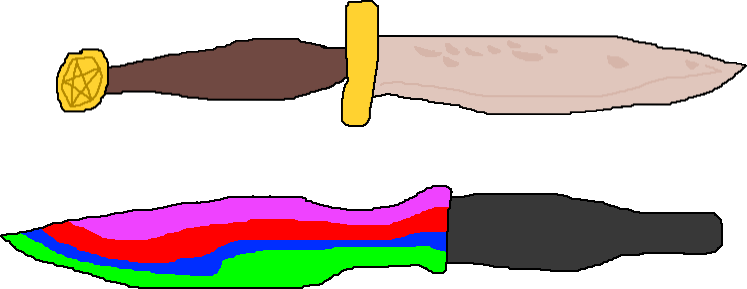
6 Deadly Daggers


[1] Lungpiercer
- +2 Magic Dagger
Stats- 1d4 + 1d6 + 2 "Asphyxiation" Damage

This magical dagger is a fearsome tool for assassins. Every wound made by this weapon seems to pull the breath away from the victim; even wounds cut into the arms and legs. Blood drawn by this weapon bubbles, as though your breath is escaping through each open cut.

Whenever this dagger deals damage, the total value of damage is applied as a magical curse. If the amount of damage an enemy has from this dagger equals their Strength score (or HDx2 + To-Hit bonus of a monster), they are unable to yell or call out for help and can only speak under the lightest whisper. They also cannot run or sprint, as though they just can't catch their breath, or cast spells. Beings which do not need to breathe are immune to this power.

Naturally, those harmed by this weapon are in great danger even if the assassin leaves them before the job is done. Only a healer will know how to open the airway and restore the victim's breath before they go under for good.

[2] Blade of the Barracks - +1 Magic Dagger
Stats- 2d6 + 1 Damage, +2 AC

Broad blade with a gold-leaf decorated face. Barely suitable as a tool of a stealthy killer, but renowned in the world of duelists and armed city officials. While wielding this dagger, you get +2 to AC as it magically aids in deflecting enemy blows and parrying the strikes of others.

The blade is a handsome weapon; and one of the few reasons a stealthy killer might announce their presence to their victim before striking- even giving them time to arm themselves and prepare their guard. It is a tool for a gentleman killer. Even if you get caught by your target before you strike, they will find you strangely approachable despite you planning to kill them and all. Anyone openly carrying this weapon also gains a +1 to their Charisma modifier, improving reaction checks and increasing their loyalty with retainers and making them more likeable.

[3] Medicine Knife - +2 Sorcererous Implement
Stats- 1d4+2 Damage

Made of sharpened antler and inscribed with arcane symbols- this magic item is rarely seen without a sheathe of fox fur and stone beads adorning its side. It is the tool of the shaman and witchdoctor, and may have been the preferred weapon of a very ancient and powerful sorcerer. While any shifty eyed killer could make good use of this knife, its true power is more aligned with the mystic and natural world. It has the aura of ancient, primal magic and is known to be "strong medicine".

The first power of the knife is its mystic ability to penetrate through magic barriers and defenses. AC gained from magic spells is ignored by this dagger. This does not apply to magic armor, whose protection is physical as well as magical. This knife can simply penetrate invisible barriers and magical protective auras; making it an ideal end to sorcerers.

The second, and more deadly power of this knife is that it can "hold" a spell inside it. If a magic user casts a spell on this knife and binds the spell within by cutting their wrist and taking 1d4 damage from the bloodletting- they can imbue this knife with a single magical spell. Later, the knife will activate the spell on the next target that it strikes. The knife could be charged with a powerful offensive spell, dealing direct damage on an enemy upon a successful stab. Or the knife could even be given a healing spell; you make a light scratch and suddenly wounds all over your body are closing. However, the knife will always activate this spell on the next target it hits, so you cannot use the bound spell until you are sure this is the one you want.

[4] Eight of Pentacles - +1 Magic Dagger
Stats- 1d8 + 1 Damage

This weapon looks like it was made by an apprentice blacksmith. Its metal is warped and the forgemarks are still blatant above the metal; but it has a strange power. Every time it takes a life, it seems easier and easier for the blade to be guided for the organs, arteries, and other weak points of a living creature as if it learns within the hands of a killer. It is empowered by occult magic and undoubtedly sadistic.

Each innocent person you kill with this knife gives it 1 minimum to its damage roll. If you kill 8, then it will always do maximum damage. This lasts until the dagger is lost; each owner must score these kills again for this effect.

[5] Polecat Point - +2 Magic Dagger
Stats- 3d4 + 2 Damage, +2 Dex Modifier

Possibly the greatest and most infamous of all magical assassination weapons. The Polecount point is a sharp stiletto with a black point along its light-silver body- not unlike the animals for which it is named. The dagger deals a very reliable amount of damage; and grants its user an increased Dexterity score of +2.

This weapon also grants the speed and flexibility of the mink. Anyone who wields this weapon becomes extremely flexible, and can move at a full running speed while crawling, climbing, or stooping under things. This ability extends beyond the simple increase to Dexterity when wielding this weapon- the most lumbering will become almost contortionist-like in their flexibility. Once, this weapon was the signature tool of a great killer-for-hire, who could hide within the smallest spaces to await the right moment to strike.

[6] Rainbow's Edge - +1 Magic Dagger
Stats- 1d4+1 Damage

This neochrome dagger constantly shifts and changes its color. While the dagger alone only hurts the same as a slightly enchanted dagger would; its true power is in the colors of its blade.

Whenever this dagger is unsheated, it turns a random Normal Color. The dagger passes through anything of the same color as it as though it wasn't there. If you strike an opponent wearing a bright red tunic, for example, and the dagger is red, it is counted as an automatic critical strike as it passes through their skin and muscle and strikes the organs within. Every attack hit with this dagger against a creature wearing or of the same color as it takes enough damage to drop to 1 Hit Points remaining, or an automatic killing blow if the attack roll is a 20.

If you aren't sure the color matches, roll a d6 with an x in 6 chance of it passing through, with X being how close the colors are to each other.

Thursday, May 19, 2022

[Class] Crow Reaper

Crow Reaper
HD-
d6
Max AC-
14 / Minimum Hit-Points- 2

You are a Crow from another world. The bipedal birds are swift, dexterous fighters- though not as tough and durable as other races. When generating a character, roll 2d8+6 for your Dexterity score. Otherwise, roll your stats as normal. You start with +1 To-Hit and AC from passive evasion.

Your job is to harvest the souls of beings from other worlds. Most beings will simply pass on when their time runs out; but especially powerful souls have ways of extending their lifespan. When souls get too old and powerful, they begin to go insane and become demonic, hence the need for specialists when a Soul gets too tough to pass along on its own. This is where you come in.

Crow Reapers gain +1 Damage at 4th, 5th, 7th, and 8th level.

Crow Reapers gain +1 To-Hit at 3rd, 6th, and 9th level.

You can also cast spells. You have no ability to learn or prepare spells yourself, but if you are ever granted spellcasting abilities, magic dice, or other elements of magic you can use them yourself- use your To-Hit bonus as your effective caster level when you cast a spell.

At 1st level, you are assigned to collect the soul of a powerful immortal being in the setting. This could be an immortal lich or vampire, an elder dragon, an aboleth, or any other powerful being that has lived far beyond when it should. Technically, you are an immortal yourself; but your aging is "unpaused" as long as your "door" remains open.

You come from the Land of Doors. When a soul is assigned for collection, a door will open- this is your door. Your character will appear from seemingly thin air- a magical locked door that keeps the riff raff out of the Lord of Door's domain while you do your business in this living realm. When you collect the soul, you will need to bring it back through this door before it can manifest itself a body again, or fly away from you when you're not paying attention!

Upon reaching 10th level, you become a Gray Crow and can now retire to the Land of Doors as a secretary or manager role. Besides becoming almost immortal, this will grant you the ability to call in some favors and open doors between worlds. Anyone entering a door will enter into the Land of Doors, a safe neutral zone where no wandering monsters exist, and can exit out of a different door to rapidly travel between places in the campaign world. You are also free to explore the living world yourself; but the longer your door remains open, the more you will age.

While the power of the Lord of Doors is awesome, it comes with limitations. Doors cannot be placed in an area where the crow has not been, except for the first door that begins their contract. Also, doors aren't placed within random chambers, but instead at crossroads. You couldn't place a door in the treasure room of a dungeon to easily haul it all out, but you could place one at the mouth of the dungeon and one at the town, thus bypassing the need to carry it back home.


Note- Is this overpowered? Almost certainly. However, I kind of like the idea of a 1st level character being told they have to kill a giant monster or demigod and the whole campaign they're kind of gearing up and preparing for it. I think that's fair in exchange for something a decently high level magic user can just do multiple times per day anyway.