Showing posts with label complete ruleset. Show all posts

Sunday, October 10, 2021

Land Before Time OSR


You're a dinosaur. Every character is a race-as-class. You could probably use normal stat generation for this and then pick whatever dinosaur fits your stats or maybe pick the dinosaur first and do an array or weighted roll or something to make a decent stat spread, whatever.

Here are the classes.

Longneck - d8 HD
Prime Requisite- WIS or INT
Attack- Tail Whip at 1d4
AC- 10

The largest and eldest of all the dinosaurs; longnecks are known for their wisdom and temperance. Their long necks provide them make them excellent scouts who can see for long distances, which along with their intelligence is the reason they so often lead dinosaur herds. They are huge and have long, whip-like tails used for self defense, but lack in offensive power.

Whenever a random encounter is rolled or you are trespassing through dangerous territory- the Longneck gets a X in 10 chance to see everything approaching from a distance far enough to go around or hide. X is determined by their number of HD.

Longnecks grow the biggest of all the people of the Great Valley. While they start off relatively small; they grow the largest over time. Instead of a HD cap of 6, your race has a HD cap of 9. Additionally, once you get to 7 HD or bigger you take 1 damage from any bite or claw that belongs to any species except for a Sharptooth.

Threehorn - d8 HD
Prime Requisite- STR
Attack- Headbutt at 1d6
AC- 16

Thickly built and well armed, these are the most fearsome of the Leafeaters. Their heads are protected by crests that grant armor and are named for the three horns that they use to battle Sharpteeth. Their horns and armored crests also grant them great protection, but attacks by smaller and more agile dinosaurs against the back of the neck or the body could ignore this protection.

Threehorns are known to be quite stern and protective of others. Threehorns can willingly take an attack meant for a teammate if they are next to them; once per round.

Spiketail - d10 HD
Prime Requisite- CON
Attack- None, then later Spiketail at 1d6
AC- 12 then later 14

Spiketails are large fourfooters that grow spikes on their backs and on the end of their tails as they grow older. As hatchlings, they can only tackle or weakly bite (1d2 damage) anything as an attack, but once they reach 3 HD they develop spiked tails, which can be whipped as a 1d6 attack, and the spikes on their back fully develop to grant them bonus AC.

Flyer - d4 HD
Prime Requisite- DEX
Attack- Beak Peck at 1d4
AC- 10

Possessing a cloak of skin that allows them to catch the air, Fliers can fly. As hatchlings (1 to 2 HD), they can only glide to varying lengths, or must catch upward thermals to gain altitude, but once they fully grow they can fly under their own power. Flying is exhausting and at least one turn of rest must be made for every X number of turns in flight, with X being their HD + Constitution modifier.

Swimmer/Bigmouth - d6 HD
Prime Requisite- CHA
Attack- None
AC- 10

Swimmers are medium sized twoleggers who are adapt at water and on land. They have a large flat mouth and a long, hard crest on their head that grows with age. They can swim in the water better then anyone else and can hold their breath for their HD in turns. They are not especially fearsome in combat, lacking horns or claws to fight with, thus needing to use other tactics to avoid predators.

Bigmouths can blow air through their crest to create a loud trumpet sound- which can be frightening to other creatures. This ability is absent as a hatchling; Once the swimmer has 4 HD or more they can perform this move. The trumpet can scare away 1d6 + CHA modifier worth of Sharptooth in HD. They can only perform this move once a day.

Clubtail - d8 HD
Prime Requisite- CON
Attack- Clubtail at 1d4+1
AC- 14

Large fourleggers with hard shells of armor on their bodies, and large shell formations on the end of their tails that can be used to deal blunt damage and crush opponents. This weapon can do anything a blunt weapon can do that a sharp one can't- like crush rocks or break teeth, etc.

Additionally, add your Strength modifier to your weapon damage.


Progression
Everyone starts as a hatchling- a 1 HD character without all your abilities. Instead of gaining XP, you level up by staying alive for an adventure and having "time pass" between them, which can only happen after you accomplish your goal.

Whenever you are told, you will roll one HD of your class and add that to your Hit-Point total. As you level up, you will unlock new abilities based on your class.

All of your characters are assumed to be young dinosaurs with parents and relatives living in the Great Valley, the only safe place left for Leafeaters- with exception to story seed [1].

Items & Equipment
Nobody wears clothes and nobody really crafts anything. However, certain items can be used by twoleggers, who have inferior stats to fourleggers as a trade off. Fourleggers can carry items only in their mouths or on their backs, but twoleggers can use their upper arms for basic manipulation.

Sometimes, items are infused with sentimental value- a "snuggling stick" or "lucky treestar" if you will. This item can be expended to roll with advantage on a single roll- but the item will always be lost or destroyed in the process, or no longer relevant as the individual learns that they do not need it anymore.

Alignment
There are only two alignments, and they are based on diets. Leafeaters and Meateaters. These are racial alignments. Omnivores or those with alternative lifestyles; egg eaters, insectivores, or Sharpteeth that "eat veggies" are all suspect and not to be trusted.

Also, there are alignment languages. Sharpteeth speak "Sharptooth" which can only be spoken amongst each other, though they may be able to understand the words of Leafeaters.

Magic
There is no magic. If something is totally beyond your power in doing- a dinosaur is deeply sick or the watering hole has dried up, you can ask an Elder Longneck and they have an X in 20 chance to know some obscure knowledge that may help you. All "supernatural" elements are confided to rare plants that may have medicinal properties, unusual astrological events that make people act weird, or rare crystals that may have special effects.

Story Seeds - Roll 1d6 for a Random Story Seed
[1] You are living in the dying world at the end of the age of the dinosaurs. You must find a fabled "great valley" that is a home for Leafeaters.

[2] An unusual lone egg has ended up in the great valley- and once it hatches, it is revealed to be the egg of a Sharptooth hatchling!

[3] The ground cracks and large tar pits begin sprouting up in the great valley; several dinosaurs are at risk of getting stuck inside and dying, not to mention sucking away all the edible plants. You must search the caves underneath the great valley to find the source of it and see if there is a way to stop it.

[4] After a disagreement with the herd, one dinosaur has left the great valley all alone. If you don't bring them back, they will almost certainly die.

[5] An unusual comet is seen overhead. In the coming days, several unlucky injuries and bad things happen in the valley, including a swarm of Swarming Leaf Gobblers. The valley is believed to be cursed and something must be found to break the curse.

[6] Several packs of Sharpteeth have found The Great Valley; and it is under siege! No dinosaurs can get in or out safely, and the Sharpteeth outside have a 1 in 6 chance each month to find the way in until they are driven off.


Small Bestiary

Fast Biters (AKA Velociraptors)
HP- 2d6
AC- 10
Attack- Bite at 1d6 and Claws at 1d4
Intelligence- Medium
Numbers- Groups of 2d4

Belly Draggers (AKA Deinosuchus)
HP- 4d8
AC- 16
Attack- Bite at 1d10+2
Intelligence- Low
Numbers- Usually one

Sharptooth (AKA Tyrannosaurs)
HP- 3d10
AC- 14
Attack- Bite at 1d12+2
Intelligence- Low to Medium
Numbers- 1 or 2

That Sharptooth (AKA Antagonist of the first film, "Rex", "One Eye")
HP- 4d10
AC- 15
Attack- Bite at 1d12+4
Intelligence- Medium
Numbers- Just one

Wednesday, July 14, 2021

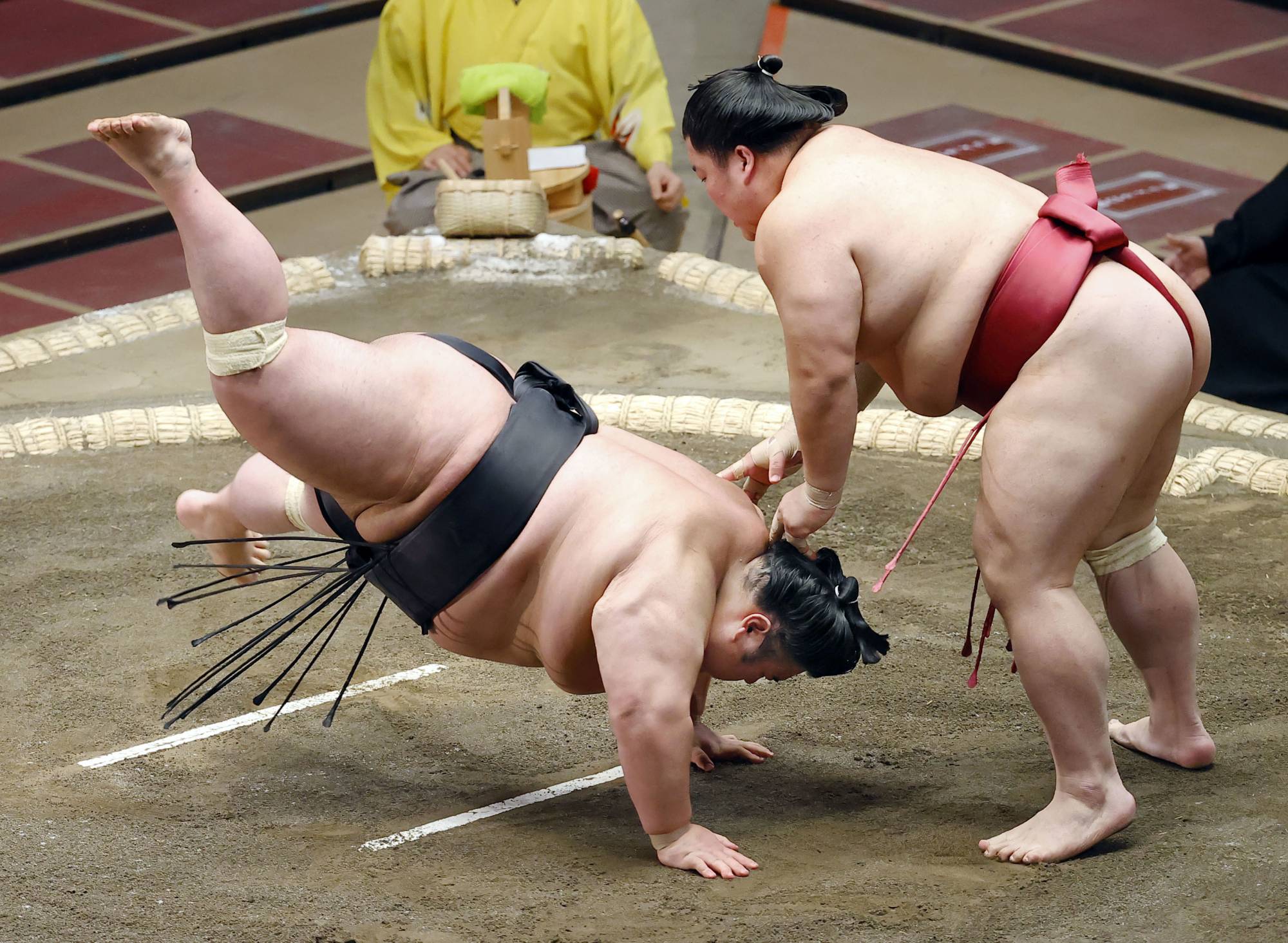
Battle at the Basho - Sumo Ruleset

I've been watching Sumo recently. God knows why. But this sport? This is a good sport.

Before we begin, let's give a glossary of terms.

Sumo is the name of the sport.
Rikishi is the name for the wrestlers.
Basho is short for "tournament".

^Hakuho Sho

Rikishi
To create a Rikishi, you must assign and/or roll your stats. Every Rikishi has four stats.

Strength is a measure of pushing, pulling, and striking power.
Height is a measure of the wrestler's height, which determines reach and weight.
Bulk is a measure of the rikishi's fat and roundness. Helps in ways you wouldn't expect.
Technique is the final statistic, based on experience, skill, and speed.

Every stat must have at least 1 point in it, and you can only put a max of 4 in a stat to start. You have a total of 9 points to spend.

Protip: You could also totally port this into any kind of semi-generic wrestling and/or brawling system. Just change "Height" to something like "Speed" and "Bulk" to something like "Toughness". You'll also have to change up the moves to help it make sense.

Bout Rules
In each bout, the Rikishi will face one opponent. They must either force the opponent out of the dohyō (wrestling ring) OR have any part of the opponent's body hit the ground except the bottom of their feet. Both Rikishi will begin in a squatting position, and when both of their hands touch the ground, they will run into each other to attempt to force the other out. Sumo bouts are very explosive and can be over in seconds, or go on for minutes of prolonged wrestling based on the strength, endurance, and longevity of the Rikishi.

For the purposes of game abstraction, we'll split the dohyō into three abstract zones. Center, sides, edge. Leaving or getting pushed out of the "edge" zone that doesn't move to "sides" means a loss, as you've been pushed out.

Each "zone" is occupied by one wrestler at a time, except the center. This means if one rikishi is on the "sides", then the other one isn't on the sides, and is either on the edge (getting pushed out) or in the center (and pushing their opponent out). This means both Rikishi will be either in the center, one center one sides, one sides one edge.

Each Bout begins with a clash, where both wrestlers spring into action. To determine this, add your Strength + Bulk score and roll a d6. If one Rikishi gets a result twice as high or better then the other, then their opponent is pushed back to the Sides from the impact. Otherwise, both are against each other in the center.

Action Rules
Every round, each Rikishi can perform an action. Actions are thought to occur more or less simultaneously, so if you push the enemy Rikishi and they push you, you can imagine you're pushing each other.

Pushing is the basic action. Combine your Strength + Height against the enemy's Bulk, both sides roll a d6. If you succeed, your enemy is pushed back one zone. If you fail, nothing happens.

Striking or palm thrusts are allowed in the rules of Sumo- punches aren't, but a mean slap or palm strike can feel almost as bad as a fist. Whenever you strike, add your Strength + Height against the enemies Height + Bulk; both sides roll a d6. If you succeed, the enemy is pushed back a zone and gets a -1 to their next roll. If you fail, you give the enemy an opening, and they get +1 on their next roll.

Sidestep is a high speed technique, and the reason why smaller wrestlers can sometimes win out against bigger ones. Roll a d6 + your Height and Bulk versus the Enemy's Height minus your Technique. If the enemy has a lower number, they move into your zone. This only works if the enemy tried to push you last round.

Grabs are done when one Rikishi grabs the mawashi (the diaper thing they wear) of the other in an attempt to flip them or gain more control over the opponent. If your bulk is twice that of your opponent, getting a good grip will be hard and they get-1 to grabs against you. There is no roll to perform a grab, but it takes one round where an opponent can use their full force to push you or strike to keep you at bay.

Once you grab the opposing Rikishi, you must then choose an action. You can either lift the enemy wrestler, or attempt to flip them. If an opponent grabs you, then whoever is taller gets to go first.

Lifting requires a roll of Strength + Height against the opponents Bulk + Technique with both sides rolling a d6. If you succeed, you "walk" them back a zone and they are forced to roll again next round to escape.

Flips require a roll of Technique vs Technique + Height, with both sides rolling a d6. If you succeed this roll, the enemy Rikishi is pulled off their feet and slammed or rolled onto the ground, which means you have won the match.


Is this ruleset shit? Probably. I didn't playtest it. I was half asleep marathoning a sumo tournament on twitch during covid when I wrote it. Forgive me. 仕方がない

Monday, October 26, 2020

Dickhead Barbarians

The full title of this game was closer to “greedy dickhead barbarians who want to rape and pillage and you play as the bad guys (as in the barbarians)”, but I couldn't really find a way to sum that up sufficiently. Also, this entire game premise was inspired by one picture.

Art @Jaroslaw Marcinek
Dickhead Barbarians
You're a bunch of barbarians. You live in a land of ice and storms. Your people are not smart- though they are tall and strong, most math does not progress beyond counting on the fingers. You get angry easily, and beat your wife to take out your frustrations. You farm greasy, measly potatoes that are just as often caked in rot as not. Craftsmanship does not exist beyond the most basic of armor and weapons- all art is shunned except for the epic poetry of your ancestors and their martial deeds. Your industries exist only off of the ever-shrinking supply of game and fur to trap. Your shamans channel the demands of evil, gluttonous gods who are the only reason you are still alive in their wretched land; despite the constant human sacrifice, painful scarification, and horrible nightmares that these divine beings tend to inflict upon you and your people.

But far away, there is a city. It is a huge walled place, where the sun shines brightly and green plants grow strong and tall. The city is somehow touched by the sun and warmth, snuggled between two mountain passes. Past this massive walled city, which is like a fortress, these people live in green and plenty. The people here are kindly, advanced in math and science. They eat well and many are even fat. They possess healing arts; their priesthood are women- sun priestesses who channel the power of fire and life. The people there only worship the Sun, the life giving, and the only spirit that speaks to them is the Old Man in the Stone. It makes no demands or sacrifices, only imparting wisdom and then slumbering again for another generation. Sometimes these people, who you have dubbed “the nice people”, send envoys to your lands. They tell you to not beat your children, and educate them with runes and writings instead. They give you blankets freely, to ward off the chill, and have even sent breeding pairs of domestic yaks and arctic rabbits for your people to farm. The moment these envoys return back to the mountain pass, these animals are quickly devoured and your bellies filled.

You know what? Fuck the nice people.

Dickhead Barbarian Generation
When you create your character, roll a d20
If you roll a 1 or 2, you are a Pygmy.
If you roll a 3, 4, 5, or 6, you are an Ice Warrior.
If you roll a 18 or 19, you are a Shaman.
If you roll a 20, you are a Cannibal Giant.
If you roll anything else, you are just a Barbarian.

Pygmies are small. They are even a little smaller then the nice people, who already are about a head shorter then the average man of your race. You are not treated very well among the Dickhead Barbarians. You are commonly beaten, berated, insulted, and stolen from since there isn't much you can do about it. This has made you crafty. You can pass as a Nice Person from a distance, if you're wearing a shawl and hide or dye your devil-red hair. You can sneak through windows without making a sound, and you can slit throats of sleeping foes without them waking up and screaming. You can also excuse yourself from any combat once the dice have been rolled- your “honor” isn't worth much.
You have a combat value of One-Half and can take One wound before you start dying.

Ice Warriors are tormented individuals. Usually they are bastard children, who are not treated well in Dickhead Barbarian culture. Almost all were once poor and own no land. Most of them, chosen between lonely suicide and absolute poverty, undertook a great pilgrimage. The Ice Warrior wandered the coldest lands to the north, even less hospitable then your homeland, and kept going until they found the pools of water in the ice that never melts. By drinking a handful of water, each drop burning your throat like fire, you became one with frost and it was the only way you were able to return. Around the ice pools remains the bones of those who didn't have the strength to sip from those cruel waters. Your eyes turned bright blue and your skin always cold. You are now immune to fire and are also tougher then a normal man.
You have a combat value of One and can take Three wounds before you start dying.

The Shaman are the religious elite of your people, while respected and feared by the people, also the subject of terrible burning brands placed upon your skin and the subject to many experiments that drained your body. You were changed by the gluttonous gods. You also know some basic arts of healing and can suck the venom out of another person's veins; doing so takes a character out of the Dying state from poison and puts it into you as one wound. As a Shaman, you have the powers of magic, and can cast one of three spells. Roll a 1d3 to determine what spell you get;
  1. By chewing up a handful of grasses from your homeland, mixed with your own blood you create by biting your cheek, and chewing for a few minutes (at least one exploration turn), you can create a solid nugget of black bile. This black bile can be spit into the wound of a warrior and rubbed in to heal them, which works on both burns from fire as well as the wounds of swords and spears. You can also spit this nugget directly in the mouth of one of the Nice People (they must be captured and helpless for this) and when they struggle and swallow the nugget it will force them to answer one question you ask them truthfully. The grasses used in this spell can only be gathered and prepared correctly by a shaman, but are not especially rare or valuable. You can prepare about 5 uses of this spell each time you leave your homeland and you venture to the land of the Nice People.
  2. By scratching and clawing at your bare skin and giving yourself one wound, you can make any animals that hear your screams go into a berserk panic. Horses buck their riders, sacred komodos rush at the nearest mammal in a hungry craze, loyal dogs flee or bite their masters. You also gain permanent claws on your hands, long and twisted, a 'gift' from the gluttonous gods that have so marked you. You can use these claws as well as any weapon, thus you cannot truly be unarmed unless your hands are cut off from your body- if you have this power increase your combat value to One.
  3. By chanting prayers and waving your arms through an angry, feral dance you can whip up the winds. The winds howl overhead and can be directed by your motions; putting out fires, knocking away arrows, or breaking the morale of cowards. You can use this power whenever you wish, but only outdoors and only at night.
You have a combat value of One-Half and can take Two wounds before you start dying.

The Cannibal Giants are a rare breed among your people. Mothers who give birth to a giant are often killed by it; even the baby is huge. They are pale skinned and have six fingers on each hand. Strangely, they are among the most calm and simple creatures that live as a Dickhead Barbarian, save for their roughly one month cycle of an inescapable urge to kill and eat another living person. They stand about a head and a half taller then even a standard Dickhead Barbarian, making you even more utterly terrifying to the Nice People. You can break the morale of untrained soldiers just by charging at them.
You have a combat value of Two and can take Three wounds before you start dying.

The Regular Dickhead Barbarians are the standard, normal man among your number. They live hard lives, and are jealous and angry at the world, and at the Nice People in particular. Whilst not special in any given way, the standard barbarian gets an extra piece of equipment for free.
You have a combat value of One and can take Two wounds before you start dying.

Equipment
Whenever you generate a Dickhead Barbarian, you get to pick two items. Regular Dickhead Barbarians roll 1d10 and get a random extra common item for free. Along with these, you automatically cobble together what funds and food you can to have enough food to travel for two weeks, a set of warm traveling clothes, and a sturdy, well made iron axe.

[1] Sword- This is a status symbol among the barbarian people. Every man is trained in use of the axe, but the sword is a nobler weapon. As long as you possess a sword, you can parry enemy attacks and no longer take a wound on a tied combat roll- it does not improve your combat value.
[2] Javelin- Just a ranged weapon. Lets you engage with enemies up small embankments, or plant them in the ground to make a make shift barricade. Your barbarians can use bows but don't make them or train with them- the gods consider it coward's warfare.
[3] Shield- Painted with clan colors. Can be used to protect you from the first wound you would take on a campaign- either from weapons or fire arrows (but not magic fire). Lost after one use.
[4] Healing Kit- Filled with ointments, bandages, basic surgical tools, and strong alcohol. Healing kits can be used to heal normal wounds, but not wounds from fire. Each has 2 uses.
[5] Packbeast- This poor, shrunken little donkey is what passes for a domesticated beast of burden among the Dickhead Barbarian people. It can carry stuff for you but more importantly it can be used as a source of food in case you run out; a group of men can eat for about a week off one donkey.
[6] Grappling Hook- Used to climb walls, obviously. You can't climb the main outer wall of the great city of the Nice People with just this.
[7] Poisoned Meat- Can be fed to dogs by throwing it over a fence or thrown in the path of a rampaging komodo-beast. Normal komodo beasts and many other well-trained war animals of the Nice People will not eat it. If a Cannibal Giant finds this meat during one of their “episodes” and isn't told it is poisonous they won't be able to help themselves from eating it. Anything that eats this meat will die after one turn.
[8] Wooden Mask- The Nice People are sometimes said to be frightening by the size and harsh faces of the Dickhead Barbarians. Wearing this mask may put them at ease long enough to draw them out.
[9] Helmet- Makes you immune to the extra wounds caused by slingers.
[10] Battering Ram- Capped in iron, it is quite a struggle to keep a log of this size from being burned to survive a winter in the barbarian homelands, making it quite valuable. Can be used to batter down doors a little faster then chopping through with axes- requires two men to carry it around or one Cannibal Giant. Those who carry it cannot sneak around, as it is very cumbersome.
[11] Horn of Ice-Water- Hollowed out horn of a goat- within is a small amount of water from the mysterious ice pool. Away from the magical pools they lack the power to change a normal man into an Ice Warrior, but drank by a normal man they can gain immunity to fire as the Ice Warriors have for one day's worth of campaigning.
[12] Bloody Warpaint- Crafted by the shamans, this magical warpaint can be put on a warrior before a battle to increase their combat value by one. It fades after this one battle, and cannot be used if you are surprised in an ambush- it must be prepared and applied over an exploration turn.

Combat
Surprise
Whenever you get into a fight, first determine if either side has surprise. Surprise in this case is an ambush; attacking a camp at night, drawing your weapon during a peaceful truce, leading them into an ambush, coming out of a disguise and so on. If two forces meet around a corner or you bust into a house with soldiers in it it's not surprise, that's just normal.

If you surprise the enemy, you may deal one wound worth of damage to a single, high value target among the enemy ranks. This one wound of damage is done regardless of the actual combat value of the unit inflicting it; as long as you had a method to deal that damage. Using javelins or pygmies, for example, are both great methods of this.

If the enemy surprises you, then one character in your party takes a wound at random.

Combat Resolution
Add up the total combat value of all the units on both sides; both the Dickhead Barbarians (players) and the forces of the Nice People (or other Dickhead Barbarians, since infighting will probably happen)

Then, each side rolls a 1d6 and adds it to the combat value.
The side with the higher combat value wins.

If the players win, they kill or route all of the defending units. Most of the Nice People can only take one wound and then they die, but some named characters may instead take a wound and flee, or be put into the dying state and then flee, but will die by the end of the day.

If the other side wins, the players all roll and have a 1 in 3 chance to take a wound and are repelled.

If the battle is a tie, both sides are repelled and no headway is made. The players all have a 1 in 6 chance to take a wound, and the enemy defenders will have lost 1/6th of their numbers.

Example combat- The players include two barbarians, a shaman, and a cannibal giant. They knock on the door of a simple farmer's hut in the lands of the nice people. They come in and demand the farmers give them all their food. The farmer submits, but not before taking out of a knife and stabbing the ringleader of the barbarians in the hand (sneak attack). The farmer is retired elite soldier and you can consider his combat value of 1. His sons are part of the milita, but are scared and cannot fight effectively against the Cannibal Giant, meaning the farmer fights alone. He has a combat value of 1 and your party has a combat value of 5.

You easily dispatch the farmer, but you took one wound. You kill the sons, take the daughters, and break into the cellar to look for any ale.

Fire
Normally, combat resolves with a 1 in 3 chance to take a wound only if you lose, 1 in 6 if the battle was a tie, but if the players win they take no damage except due to a surprise. Fire is the exception. Fire is an incredibly powerful force, and is used by the defenders in the form of flaming arrows, or magic done by the Sun Priestesses.

If fire was present and used against the players in combat, for any reason, then every player-character has a 1 in 6 chance to take a wound after combat ends- win, lose, or draw. This includes if fire was accidentally set, or the building you are in was lit on fire. Players can also use fire, such as trapping an enemy in a burning building or stealing fire arrows to use for themselves. In such situation, boost their combat value by +1 for each source of fire. Ice Warriors and those who drank from the Horn of Ice-Water that day are immune to fire.

Damage
Every character can take wounds. If wounds are inflicted, your character feel the pain and must suffer with them until they are healed by some method. Healing kits can heal wounds from normal weapons, but only a Shaman can cure burns with magic. If you reach your wound limit, determined by what kind of Dickhead you are, then you are put into Dying. If you take a wound while in the dying state, you die instantly. One week of bed rest is enough to cure a wound- camps and marches do not count.

The Dying state means your character is limping and on their last legs. You can still move, fight, and speak but are running out of strength. Treat your combat value as half. Unless you are healed by a healer's kit or magic you will die in the night while sleeping in camp. Also, taking another wound kills you instantly. The only other way to escape the Dying state is to be very well rested and have bed rest- your warrior's camp is too harsh, but a locked, fire-warmed room with a bed and plenty access to water and food will suffice. You have a 1 in 6 chance to die even in these good conditions, otherwise recover one wound after a week of bed rest.

For example, a Pygmy will be put into dying after taking one wound. Ice Warriors and Cannibal Giants will enter dying after taking three wounds, and so on.

Enemies
Milita- The weakest enemies, not even half as effective as a regular soldier. They make up the general population, and fight with standard spears and little to no armor. They are cowardly and can be scared by magic or giants. Most of them will die in the event of fire and can be easily chopped apart by an axe.
They have a combat value of Zero.

Soldiers- The standard soldier. Note that they are better trained and armed then you are; they have full bodied shields, full body armor, and short swords. However they are physically small, soft from their days of civilized life, and lack the killing instinct the Dickhead Barbarians do.
They have a combat value of One-Half each.

Standards- These are soldiers armed with no weapons or shields; they only carry a war banner. Their banners are red and gold, edged with silver bangles, and inspire greatness to the hearts of the Nice People. The banners are magic and shimmer in the sunlight. If a Standard-Bearer is present in a battle, all of the standard soldiers fight with a combat value of One. Killing these before the battle beings with an ambush will be a very important tactic to the Dickhead Barbarians.
The Standard Bearer alone has a combat value of Zero.

Slingers- Lightly armed soldiers trained with slings, often recruited from local shepherds, they are most commonly seen in the envoy of the Yak Kings. Before a battle begins with slingers present, every Dickhead Barbarian has a 1 in 10 chance of getting wounded by a slinger's shot. They can only hit a maximum number of Dickhead Barbarians even to their own numbers, so if 5 slingers are present in a battle against your 10 barbarians, only half of them will roll to see if they were hurt, determined randomly. Helmets protect against slingers. Also, after the first round of combat and they release their volley, Slingers are not given armor and only have a dagger to defend themselves, as such they have no combat ability and are cowardly as militia. If you want to make slingers more deadly, make it so that if they double or triple a barbarian party they will have a 2 in 10 or 3 in 10, etc, chance to deal a wound to each barbarian.
Slingers have a combat value of Zero.

Archers- Deployed only as defense on the great wall or other fortresses. They dip their arrows in sunlit oil which ignites as it flies through the air with a harsh whistle. They count as a source of fire, but only during the daytime.
Archers have a combat value of One while fighting defensively on top of a wall or in a tower. If they are in an open field or indoors, their combat value is changed to Zero.

Sun Priestess- Calling upon the magic of their people; the Sun Priestess can channel fire and light through her magic. They can cast this magic at any time of the day. The Sun Priestesses wear red and golden gowns and wield magic staves made of brass topped with bright rubies. With a flick of their staff, fire is conjured and launched at her foes. She counts as a source of fire. Sometimes, Sun Priestesses ride on top of Komodo beasts into battle; Since a Sun Priestess rides on top of the Komodo beast, it is very hard to sneak attack her unless you use a pygmy to climb the beast as it doesn't notice or by throwing a javelin.
Sun Priestesses have a combat value of One.

Komodo Beasts- These huge creatures are only ever seen while being ridden and controlled by a Sun Priestess. Without a priestess, they simply lounge on the road and wait to be fed by someone wearing the loincloth of the temple youth; they ignore everyone else. The Sun Priestesses control them through magic, and become very formidable while on top of one. If you kill the Priestess riding on a Komodo beast, the beast will enter the fight with its normal combat value, but will become cowardly.
Komodo Beasts have a combat value of Two and must be wounded Twice before they die.

Temple Guards- The most powerful and elite soldiers of the Nice People. They have glowing orange eyes and are men, blessed with magic and imbued with the waters of life and majesty. Each one has skin and hair that is so fine and handsome that it practically glows. All of them wear two to three cat paws around their necks as amulets; earned from their feats of bravery. They wear heavy armor but no shields; each uses two swords which they have the skill to use both at the same time.
Temple Guards have a combat value of Two and a Half. They are put into the dying state after taking One wound, meaning they will die in one day but will seek healing or warn others of the barbarians if they escape.

Yak King- Lesser Kings and Tribesmen of the Nice People- said to once be the rulers before the Sun Priestesses became the dominant religion. They are said to still strongly follow the forces of nature. Yak Kings are bigger then the normal Nice People, they have shaggy hair and manes, and also have two small horns that grow from their heads, like the yaks they heard in the mountains bordering the territories of the Nice People and the Barbarians Dickheads (you). If they are injured in combat, they will likely flee to a place of natural solitude, in which case they will heal in one night. You are unlikely to find any Yak Kings in the great cities, but are very likely to encounter them if you try to cross between the two territories through the mountains or passes not guarded by walls. Before a battle begins with a Yak King- they will beat on a wardrum and scream with their retinue. Your group loses -2 of their total combat value unless if you have at least three warriors bang on their shields OR you have a shaman to counter the magic. This obviously does no occur if the battle begins with surprise.
Yak Kings have a combat value of Two and must be wounded Twice before they die.

Great Yak- Normal yaks are too timid and small to provide as a weapon of war, but great yaks are different. These are yaks, herded by the lesser tribes and yak kings in the lands of the Nice People, who have grown to prodigious size. Your Barbarians will instantly harken them to the great mammoths of your land, and will have some basic idea on how to fight these huge monsters. They are usually ridden by a brave youth or a small group of warriors, who tug their shaggy hair to use them as living battering rams. If you manage to win a combat against them, they flee and will kill 1 in 6 of the enemy forces by charging through them, destroying barricades, and generally causing chaos among the enemy forces. If you manage to kill their riders before the battle begins, the yaks become useless and instead provide a -2 combat value to the entire defending force.
Great Yaks have a combat value of Three. They can take many wounds before they die but once they are defeated once they lose all taste for combat. If you manage to hunt one down after a battle you could feed your entire troop for a month.

Snake Priest- Less common then the Sun Priestesses, the Snake Priests and an exclusively male occupation within the temple. Many of them began as Komodo feeders and scribes before they were able to ascend up the ranks. The Snake Priests do not have magic as the Sun Priestesses do, except for the skills in alchemy, poisons, and snake charming. Each of them does not carry weapons into combat except for a deadly snake, which hangs from their arm and will bite whoever they choose. You can avoid being bitten by a snake priest by exclusively fighting at range with Javelins. If you engage in a battle with at least one snake priest, a number of barbarians equal to the number of snake priests in the battle have a 1 in 6 chance to have been bitten. If you were bitten, you are put into the Dying state. Pygmies die instantly because of their small bodies and hearts, and Cannibal Giants only take one wound. Snake Priests are immune to poison.
Snake Priests have a combat value of One and a Half.

Loot
Whenever the Barbarians sack a temple or palace, they will find one treasure. Temples scatter the lands of the nice people, but each city only has one palace, belonging to the royal courts. The Kings and Queens of the nice people are noble, and fight as Soldiers even without armies to fight with them. They are very honorable and are held accountable for their actions; in the past, peasants have sued their regents and won. Within each palace or temple will be a single treasure, as well as many bags and coffers filled with gleaming gold coins.

Treasure Table – Roll 1d8
[1] Golden Sword- This magic sword appears as a golden relic. It is finely made, very sharp, and well balanced. The sword is curved at the tip and feels warm just looking at it. The sword is never locked in a box or guarded by chains or locks, which should be the first clue that it isn't quite so vulnerable. If you touch the sword, you burst into flames and die. Anyone who is immune to fire can wield the sword without being hurt. It increases your combat value by One.

[2] Bottle of Venom- This bottle is filled with a swirling green mist. If you open the bottle in an attempt to drink it, it will spray poison gas and fill the whole room. Whoever opened it is automatically poisoned and put into the Dying state, everyone else in the room has a 1 in 3 chance. If you throw the bottle as a weapon; it will poison 1 in 6 of the enemy forces in an open area or battlefield, which will increase to 1 in 2 of the enemy forces in an enclosed space. All those targets are put into the dying state, which means you can avoid conflict and wait until the night when most of them have died.

[3] Stone Arrow- This magic arrow is made of stone, and carved with the tiny hand of the Old Man in the Stone gripping the arrowhead and guiding the point towards its mark. If you fire this arrow at anyone you can see, you can guide the arrow magically towards them, causing them one wound right at the start of the battle. If this occurs in surprise, increase the amount of damage to Two wounds, or an instant kill against most forces of the Nice People.

[4] Feather Amulet- Lesser artifact of the tribal people before the unification- said to bring the luck and flight of birds. Wearing this amulet decreases the chance of taking a wound up one die size for whoever is wearing it. So a 1 in 6 chance becomes a 1 in 8 chance, or a 1 in 3 chance becomes a 1 in 4 chance, and so on.

[5] Healing Wand- Small stick doused in ritual oils with a tassel of bright orange fabrics. Said to be the favored and most precious artifacts of the Sun Priestesses. If you wave this over a person who is submerged in a bath; you can bring them out of the Dying state and undo the wound that caused it, but cannot heal further wounds. If an enemy is in the Dying state but manages to retreat to a temple, they will probably be healed by one of these. You can only use this on up to 4 people per day at most, meaning if you have more dying barbarians some of them will probably pass in the night unless if you can get them proper resting conditions.
Also; any shamans in your party will have an irresistible urge to snap this wand in half, a whisper from the gluttonous gods. If they do, they will be rewarded with learning another one of the Shaman spells, determined from the list randomly.

[6] Robe of the Magi- This magical robe is laced with sapphires and is bright blue in color. It carries the magical power of the Old Man in the Stone and many hedge magical traditions not related to the Great Sisterhood of the Sun. If you wear this robe it is possible to meditate and sense the movements of enemy troops on a 1 in 6 chance per day; the nearest enemy party will be revealed to your mind in a vision. Additionally, while wearing this robe, you become immune to wounds caused by the fire of the Sun Priestesses, but not other sources of fire.

[7] Golden Mask- These masks are famed and very holy by the Nice People- they believe that only true prophets can wear them and will lead their people to deliverance in troubled times. None of them ever try to wear them, even the high ranking members of the temple, out of respect and reverance for the stuffy tradition. You can wear them though, and instantly you can use it to trick a large number of enemy forces to lay down their weapons, pass aside, or get aid from a large number of civilians, etc. This trick will only work once as the news spreads of a “false prophet” and of the evil barbarians abusing this artifact.

[8] Ruby Chain- Golden chain set with rubies and amber stones, polished and fine. This treasure has no magical or practical use, but is incredibly valuable. It is worth approximately four times as much gold then you could normally get from raiding an average temple or royal palace. You could practically buy an entire village with one of these back in your homeland.

Old Man in the Stone
Each city is said to have an ancient stone carving that depicts an old man. This is a statue of wisdom, and is not in any way antagonistic to the culture of Sun Worship or the Priesthood. It is a source of magic and knowledge, and is said to whisper to the Nice People, especially in times of trouble, to give guidance. Any given city is going to have one, a large town has a 1 in 3 chance of having one, and some truly huge independent temple complexes may also have one.

Every time you fight in a city or within a day's march of an Old Man Stone, the enemy you face will always have a combat value of +1 and, depending on how complex your plans are, may also ignore any sneak attacks you perform on them (or they may even get to ambush you with sneak attacks). This is from the knowledge of the stone as it whispers what you are doing to the leadership of the defenders.

You can destroy an Old Man in the Stone by pushing it off a cliff (being pulled by a packbeast or two), having a Cannibal Giant smash it to pieces with a hammer that takes all day, or by having the shamans perform blood sacrifice on several captured civilians; their blood running over the magic stone and desecrating it so it speaks no more.

Every time you destroy an Old Man Stone, regardless of the method used, one of the Shamans in your party can take credit for it. They pray to the gluttonous gods and permanently gain a superhuman resistance and inner strength. Increase the total wounds they can sustain before being put into the dying state by +1.

Campaign Start-
Roll 1d4
[1] Before the invasion. The great walled city that borders your two lands has not yet been approached. You will need a large army, siege engines, or great diplomacy to try and gain entry. The Nice People have not yet been alerted, only archers man the towers, no standards have been brought out of storage, the soldiers are lazy and sleepy. You could also start this campaign in the barbarian lands before anyone has gone to the land of the Nice People, perhaps a few sessions of fighting strange monsters in your frozen wilderness until you hear tales of a warm and sunny land that is ripe for the taking.
The players will probably be a smaller group serving underneath a greater NPC barbarian warlord. You may be sent up the towers and ramparts to kill the signal-fire men and archers so they can't raise the alarm as the barbarians try to get through the great walls. More of a stealth mission in the start.

[2] The Great Battle. This campaign begins while the barbarians are sieging the great walled fortress. The players will be a small strike team, either trying to take out a certain pesky heroic individual holding the line (maybe a Temple Guard or Sun Priestess) or going behind enemy lines to take out some NPC commanders or soldiers. You could also cold open the campaign right as the main walls are breached, and have the players experience a huge chaotic fight with great-yaks running down the streets of the burning city, getting into fights with random civilians as milita, and smashing and grabbing whatever they can from the first treasure room or palace.

[3] The Dying City. This game takes place after the invasion; perhaps the players are the second wave or are just a greedy group of individuals who have nothing to do with a barbarian warhost that smashed through the great walled city. Or perhaps the great walled city just doesn't exist- the Nice People didn't even have a main walled fortress to protect their lands as they were so ignorant of the dangerous Dickhead Barbarians that bordered them. The players can travel around the first city or to towns and villages in the nice people lands, raiding, and avoiding the enemy patrols of soldiers, priestesses, and other threats.

[4] The Raided Countryside. The armies of the Nice People are shattered. Most of the population has been fleeing away from the influx of barbarians- who are starting to take the land and declare themselves the new lords and rulers of this place. Only the most secure strongholds remain of the Nice People; temple fortresses. The Yak Kings are taking their people deeper into the mountains, but there is rumor of a prophecy of an ancient Yak King bloodline that has the power to expel the barbarians forever. As the barbarian invaders, the players must deal with that looming threat.

Rules Considerations & FAQ
Progression Systems
There isn't a lot of progression in this game, in fact players will probably just get weaker as they lose their starting equipment, usable spells, take losses and take wounds. However you are expected to take slaves and loot, perhaps back to the homeland or just back to your camp, and in return you will get access to more warriors, buying barbarian equipment, and healing your troops. Then, raiding temples and palaces will grant you magic items in greater numbers that will improve your party permanently. Shamans can also gain new spells by destroying certain useful magic items or gain increased permanent vigor by destroying the Old Man in the Stone statues; if a Shaman gets to four or even five wounds before they start dying you could also consider giving them new magic powers.

Also; it is somewhat implied the drawbacks of some characters (pygmies and cannibal giants) will be partially amended by successful campaigns; for example, instead of accidentally eating poison meat or having the urge to kill a fellow barbarian, the cannibal giants will be able to eat some of the Nice People they've taken as slaves- it's progression in the sense that you've eliminated a drawback. The pygmies may make up for their lacking combat value and general low self-esteem by gathering up hireling barbarian warriors to serve them with all the gold and treasure they've looted.

How do I determine how many enemies are in a “force”?
Follow the guidelines in the campaign start, or make it up as you go. I imagine forces start smaller; small groups of milita and archers. Eventually as the barbarians advance the tribal people get involed bringing in slingers and yak kings, until the great temple districts start to bring forth their Sun Priestesses and Komodo Beasts and the standard-bearers ignited by magic. Temple Guards and Snake-Priests I imagine as being more defensive, more “late game” threats you have to deal with only if you try to break into the temples or noble palaces to get your loot.

Why do some units have a combat value of zero?
For slingers (after they launch their volley), archers in enclosed spaces, and standard militia. The idea is that they are still present in the fight, but they don't provide any strength to their side in the scuffle, which is implied to be at least in large part a melee. They don't provide combat value directly but indirectly they do, in the sense that when you kill a large number of enemy troops among the slain will be the archers instead of more valuable units.

Sun Priestesses
In short; you can either encounter them alone (combat value of one, has a 1 in 6 chance to wound all of your barbarians with fire damage) or riding on a Komodo beast (total combat value of 3, 1 in 6 chance to wound all of your barbarians with fire damage). They are meant to be magically powerful but are not sturdy- the seemingly useless items like javelins in the shop are to be used against targets like this.

Yak Kings & Temple Guards
These characters are more meant to be recurring rivals or powerful foes, though not as powerful as a Sun Priestess riding her Komodo beast. I imagine Yak Kings hunting the party down every few days as long as they are in their lands, recruiting militia and local commoners as slingers to help them fight the invaders, being like a rival. I also imagine Temple Guards appearing in pairs. Temple Guards are quite powerful individually, but you probably won't see a big army of them, so their combat values will probably be nearly the same as the party. Cannibal Giants with war-paint are your most powerful single force, and they are stronger then the temple guards individually by one half a point.

What's up with Half combat values?
Half combat values are a nice break point. I consider them still useful, you could think of them as “as good as a normal soldier to have, but you can't mass them as well.” Consider a battle where the party has 4 barbarians and a pygmy or shaman, that means they have a combat value of 4.5- you'd round this up to 5. If the enemy force has a combat value of 4, then that means the enemy has a -1 disadvantage to the combat roll, same as though you had a combat value total of 5. But if you had two pygmies or shamans, you would have a combat value of 5 anyway, and the math works out the same. They're tiebreakers, but not powerful individually.

Afterward
Hey there, hope you liked this game. It was originally going to be a 40 min settings project, based on that first picture I posted, but it quickly spiraled into its own thing. The idea here was to make a setting based on the picture; I instantly thought of icy barbarians looking at a sunny, majestic empire filled with life and being jealous about it. Then I thought of having a ruleset where the players were moreso obviously the “bad guys”, but as it was developed it kind of branched out. While the Nice People are clearly nice, you'd almost certainly want to live there instead of in Dickhead Barbarian land, the Nice People were given a few antagonistic elements, like the weird tribal yak king demihumans in an otherwise all-human game world, and their obsession with giant reptiles and snakes. It's an evil campaign that isn't supposed to be totally cartoonish.

The game was very Conan inspired, with races of humans being given specific detail and traits, especially in regards to size and strength. I wanted the player characters to feel like, while maybe the bad guys, you are the SCARY bad guys. You aren't goblins, you're barbarians who are fighting the soft and decadent empire. But in the places of magic and their champions, these imperials are superior to your own forces. The Sun Priestess for example is just better in every way to one of your shamans; more powerful magic with less drawbacks and restrictions for the most part, but she is surrounded by cowardly milita and an untamable giant lizard.

So anyway, in short, Dickhead Barbarians became a weird, somewhat unique game. I felt like I had taken this blog too far in the direction of just being D&D/DIY/OSR homebrew and material. I've always wanted to have more games; I've always loved making games, even one off little projects with rules and settings combined. For this reason, I ended up really liking what happened to Dickhead Barbarians and now that it is finished I hope you did as well.

Wednesday, September 12, 2018

Manse '18

This is a collection of basic game rules for the Manse Basic roleplaying system; a DIY style game. The goal of the game is to search dungeons for treasure, crawl the wilderness, and become a powerful character within a fantasy world. Danger lurks around every corner, but treasure awaits. This is the 200th post on this blog, and for the occasion, this is the most complete ruleset posted.

Character Creation
Roll your stats, pick your class and race, and choose equipment.

Stats- Roll 3d6 down the line for all 6 stats. Your result roll determines your stat modifier.
3-4 = -2
5-8 = -1
9-12 = 0
13-16 = +1
17-18 = +2

[Strength] Add modifier melee to-hit rolls and for carrying capacity in load units.
[Dexterity] Add modifiers to ranged to hit, bonus AC, and stealth rolls.
[Constitution] Each modifier is +/-5% max HP rounded to the nearest whole number.
[Intelligence] Add modifiers to known languages and magic rolls.
[Wisdom] Add modifier to healing rolls and all saving throw rolls.
[Charisma] Add modifier to reaction rolls and starting coins.

Classes
Pick your classes based on your talents and what your party needs. There is no multiclassing and classes progress linearly; it's about what your character does that defines them.

Fighter
HD- d10
Max AC- 16
Saves- Every odd level, +1 to combat saves. Every even level, +1 to all saves.

You are the strong, powerful, determined and skilled. While others fear to face the monsters, you stand tall against them. You represent the spirit of the warrior in all its forms. Your fighting style may be advanced, brutal, practical, or flashy- all of you be Fighters. Your class is the only one capable of wielding the most powerful magic weapons and armors and unlocking the most powerful of the secret blade arts. You're also physically tough and hard to kill.

Because of your HD- you almost always go first in combat and have a 50% chance to get advantage on your attack, as well as a 10% chance to get a second attack. This is an inherent property of the combat system, and grants you quite an extreme advantage against monsters at low levels. Your minimum starting HP is also 6 instead of 2 like most classes. You also ignore the combat save penalties to wearing heavy metallic armors regardless of your level.

Every Even level, you get +1 to hit on attack rolls with all weapons.

At levels 3, 6, 9, and 10 you get +1 damage on a successful hit.

At level 5, you get +1 maximum AC. At level 7, you get +1 Leadership, which among other things gives all your hirelings +1 morale/loyalty.

At 10th level, you become a Champion. You are capable of starting your own fort- as long as you can get the money together, people will come to live under your protection against the monsters and bandits. You could buy the fort as you level and slowly build it, or reclaim ruins to use as a home base, but you don't attract anyone else or are not seen as a “true” lord of the land until you reach 10th level, even if the fort was finished before this. You also attract 40 Militia men. These fight as regular, 1 HD men divided into 4 squads. Four of these men are Captains; one for each squad and count as a 1st level Fighter for their hit points and other abilities, and could be made into hirelings or trained to become even stronger or be taught some of your blade arts.

Additionally; you gain the Mighty Cleave ability. When fighting an enemy force of 1 HD opponents, you don't roll to hit. Instead, roll damage and you slay that many of them in one round.

Rogue
HD- d8
Max AC- 14
Saves- At first level, +1 to all. Every odd level, +1 to hazard saves. Every even level, +1 to all saves.

You are the sneaky thief, the deadly Assassin, and the swashbuckling folk hero. Beyond your stealth, and ability to attack from ambush, you are also decent in a fight and are skilled with devices and skillful when it comes to exploration. Their are some gadgets, poisons, and magic instruments that only your skilled hands can ply. You are adept at avoiding danger, and get +1 to all saves at first level.

Rogues are very skilled with mechanical devices and tasks requiring skill and coordination. As long as you are using an appropriate tool, such as an iron prybar, lockpicks, climbing hooks, sandbags, and so on you can add your Rogue level to your skill checks and rolls called by the DM during rulings.

At levels 1, 3, 6, 9, and 10 you get +1 to your Stealth rolls. You can also add this bonus to both the to hit AND damage of your sneak attacks.

At levels 4, 8, and 10 get +1 to hit with all weapons.

At 10th level, you become either a Folk Hero or a Master Thief, depending on how you used your abilities and made your fortunes. If you stole from dungeons, stole from nobles to give to the poor, and sought fame and glory as well as money then you're more of a Folk Hero, but if you mostly stole for your own personal gain, used your talents as an assassin or spy, as well as kept a low profile, you're more of a Master Thief.

The Folk Hero can become the leader of a merchant caravan or fleet, or the master of a guildhall. If you're a Master Thief, you can instead gather the scum of society around you as your own personal, secret Thieves guild. Both possibilities can be taken in combination with becoming the mayor or leader of your own settlement, which will require protection from outside threats.

Additionally; you gain the ability Escape Artist. Make your way out of bindings, holding cells, and seemingly unwinnable situations once per adventure. You could also use this ability along with a smoke bomb or distraction to reenter stealth right under your pursuers noses.

Magician
HD- d6
Max AC- 12
Saves- Every odd level, +1 to magic saves. Every even level, +1 to all saves.

You are the mystical and curious of the mortal races. You have studied and can cast magical spells better then anyone else. You are a magic user- but also learned and have some useful scholarly knowledge. You can attempt to learn something about magic items as well as monster clues to help identify them and potentially learn any benefits or dangers from them. Your extrasensory abilities are more developed then most; you have an ability to sense danger. If you meditate for an entire exploration turn while sensing a suspected thing; you can sense if it is dangerous or has a trap. You can only do this if the depth or height you are within a dungeon is equal to or less then your caster level.

You treat your level as one higher for commanding/turning defeated spirits and undead. At level 5, this doubles, and you now treat your level as two higher for this purpose.

Your main ability is to cast spells. You get one spell slot per level, with levels 3, 6, and 10 granting newer spell slots of higher levels. You always fill in spell slots from the lowest open slot upwards; and ascend through the magic circles in a pyramid like progression. See the graph for an easy visualization of this method. Your spell slots can be expended to cast any spell you know of an appropriate level or less; but spell slots only return at the end of an adventure when you have time to restore your magical energies and study your tomes once again; usually this means returning to town or a base. You roll two starting spells; then must find or purchase all of the others in order to grow your grimoire.

At 10th level, you become a Wizard. You can build yourself a magician's tower or manse in an area filled with magical energy or phenomenon. Most Wizards do this in far away places and live as hermits, due to the fact you will receive 1d4 annoying petitioners each season asking you to solve their problems and grant their wishes with your awesome magical powers. What you do with them is your choice. You will also receive a 1st level apprentice Sage seeking guidance and training.

You gain no additional special powers or properties at 10th level, beyond the fact that you can now cast 4th level spells; among the most powerful and devastating magic around. Sorcerers rank and organize themselves along with the highest level spell they can cast; Magicians of the 1st circle are little more then apprentices where as a Wizard of the 4th Circle like yourself is considered a master. There are rumored to be Archmages of the 5th or even 6th Circle out there, somewhere.

Sage Spells Table
Level
1st Circle
2nd Circle
3rd Circle
4th Circle
1
1


2
2


3
2
1


4
3
1


5
3
2


6
3
2
1

7
4
2
1

8
4
3
1

9
4
3
2

10
4
3
2
1

Races
Races are determined by player & DM consensus. Once you determine your race, any special qualities you ask to have will be paired with a negative drawback of equal value. For instance, a dog humanoid with a minor bonus to use their sharp nose to help search for items and treasure, but will be susceptible to fleas as a minor drawback.

Other players may copy or play as the same race that another player has; but some races may have stat modifier requisites to play as them. If a player decides to play as a Oni and has +2 Strength, and it is decided that Oni are all very strong, everyone else who wants to play as an Oni will have to have at least +2 Strength in order to play as them too.

Rules
Hit Points- Roll your class die at first level and every time you level up after, and add that much to your hit points. Your minimum HP is 2. If you ever drop to 0 hit points or less, you die.

Combat- Roll you class HD at the start of each round. This is your initiative, with bigger numbers going first. If you roll at least 6, you get advantage on your attack. If you rolled a 10, which is only possible for Fighters, you get two attacks (with advantage) this round.

When you attack, roll d20 + to hit bonus vs enemy AC. On a hit, roll your weapon's damage. Each weapon has a damage die- if the weapon's damage die exceeds your class's HD, then you must use your class HD for the damage roll instead. Your class HD limits your damage potential.

Spells in combat take one round to cast; if you are damaged while channeling a spell that is cast or controlled over multiple rounds, make a save or the spell fizzles. Distractions like flashes of light or loud noises might give you an easy save, but failure still loses your spell.

During combat; players can attempt any sort of reasonable action such as grapples, “called shots”, using improvised weapons or tactics, the environment, and so on to get an advantage. Doing so may call for a roll or sacrifice of your attack. You can always try these actions regardless of your class; be creative in what you do.

Inventory- Items are abstracted into units of Load. Load is roughly equal to the size and weight of the item; a dagger would be 1 load and a sword 2 load, for example. Bags of 100 coins are 1 load. Very small objects may not count towards encumbrance. You have an encumbrance of 8 + Strength modifier; and each time over you exceed this number you get slower and more likely to run into monsters.

(Optional) Stow is an optional rule that limits the number of items you can access at any time in combat. The rules are found here. If you use Stow, grant Rogues +1 to Stow at levels 1, 2, 4, 8, and 10. This allows you to have more items and equipment on hand during combat.

Skill Checks- Whenever you wish to do something that requires a lot of skill or coordination, roll a d20. Rogues get a bonus to do things related to their class, like climbing, lockpicking, or playing music to lull a beast to sleep. The difficulty of the task determines how high you have to roll to succeed.

Saving Throws- Whenever you are forced to defy danger, roll a d20 and add relevant class or stat modifiers. Making the save means you have a reduced negative effect or negate it altogether. Different classes have different defenses against different threats.

Progression- Coins and treasure spent grants XP equal to the amount spent. Wasting money on frivolous things may grant +10% bonus XP. To advance from first level to second level requires 100 coins spent, and it doubles each time. To reach 2nd level is 100 coins, to reach 3rd level is 200 coins, to reach 4th level is 400 coins, 5th level is 800 coins, and so on.

Equipment
Weapons deal damage based on their size and how powerful they are. Daggers, blackjacks, slings, darts, and similar deal 1d4 damage. Swords, arrows, spears, maces and “standard” weapons deal 1d6 damage. Big weapons, like bastard swords, poleaxes, huge axes and so on deal 1d8 damage. You can use any weapon regardless of your class, but your maximum damage is limited to your class HD or less. Magical weapons have an Ego score- which means the more powerful they are, the more they try to manipulate and control the user. Only powerful Warriors- as in Fighters and to a lesser extent Rogues, can control these and bind them to their will.

Weapons are differentiated not just by size but also by the fiction of the game world. You could use a sword to cut a rope, but not a hammer. Skeletons take no damage from arrows or spears, etc.

If you use a weapon in both hands and swing with all your might; on a hit you get to add your Strength modifier to damage; but cannot use your other hand to cast spells, use a shield, grab a potion, etc. If you have a negative Strength modifier; you can do this to ignore your negative to your to-hit roll, but lose AC equal to your negative strength as you put yourself open. You can also duel wield. If you do, roll both damage die on a hit and take the higher of the both. If they match, deal damage equal to the value on one die + Dexterity modifier, positive or negative.

Armor & Shields you AC. Armors made from material like padded cloth, leather, bone, and other more supernatural materials are considered light armor where as armor made from metal or stone is considered heavy armor. Heavy armor has much higher AC per piece, but has higher load towards your encumbrance AND you get -1 to combat saves per AC bonus gained from heavy armor unless you are a Fighter. Shields always grant +1 AC, unless you're using a shield as big as your character, in which case it's considered a tower shield and grants +2 AC. Similar to magic weapons; magic armors may have an ego score and refuse to serve weak men.

Magically inclined character also have their own tools as well. If you cast a spell while wielding a staff or rod, you get +1 to the spell's damage. If you cast a spell while wielding a wand, enemies get -2 to their saving throw vs your spells. If you cast a spell while wielding a magic crystal ball, or by drawing runes on the ground with chalk, you can extend the duration of the spell by +1 round if it lasts rounds, up to a turn if it lasts a few minutes, and +1 turn if it lasts multiple turns, even +1 days if the spell lasts multiple days, but this is the limit of a normal orb's power.

Tonics are special versions of potions. Tonics are magical potions that last only 24 hours after they are brewed- if they are not drunk or used by then, they become useless. Tonics purchased in town lose their magic after this first day, but they can be made on demand and are much cheaper then potions with a longer shelf life. You can brew tonics yourself by finding and brewing your own ingredients you find.

Shopping
Starting characters begin with 300 + (Charisma modifier x150) coins to spend before their first dungeon trip. This money does not count towards XP and should be spent to give you the tools and equipment you will need in the dungeon. Characters with -2 Charisma start with rags and a single improvised weapon, such as a sharp stake or frying pan (1d2 damage).

Weapons
Name
Damage
Load
Cost
Description
Dagger
1d4
1 per 3
20
Metal, straight. Useful for cutting.
Club
1d4
1
5
Made of wood, simple. Could be burned.
Staff
1d4
1
10
Long, wooden. Spell cast with it get +1 damage.
Spear
1d6
2
25
If head removed; could be used as a long pole.
Sword
1d6
2
150
Competent craftsmanship.
Mace
1d6
2
100
Very durable.
Axe
1d6
2
80
Good at cutting wood, cutting of limbs.
Battleaxe
1d8
3
250
Huge, unrealistic, two handed. Wooden haft.
Greatsword
1d8
3
450
Huge, two handed. Good craftsmanship.
Javelin
1d4/1d6
2 p. 3
10
Sold separately, deals only 1d4 melee.
Bow
1d6
2
10
Ranged weapon, fires arrows.
Crossbow
1d8
3
90
Ranged weapon, fires bolts. Must reload.
Sling Bullets
(1d4)
1 p. 20
2 for 1
The sling is free, bullets come in Bag of 20
Arrows
1d6
2 p. 20
2 each
Cost is per arrow. Held in Quivers of 20
Caltrops
1
1
60
Scattered; deals 1 damage when moved through

Armors
Name
AC
Load
Cost
Description
Shield
1
1
100
Made of wood, painted. Smallshield.
Tower Shield
2
3
200
Fabric or hide, as tall as you.
Gambeson
1
1
150
Padded cloth, worn on the chest.
Iron Scale
2
2
250
(Heavy) Worn on chest.
Chainmail
3
4
500
(Heavy) Worn on chest.
Chain Cowl
1
2
150
(Heavy) Worn on head.
Iron Helmet
2
3
350
(Heavy) Worn on head. Horns optional.

Magic
Name
Load
Cost
Description
Healing Tonic
1
50
Restores 1d6 hit points. All tonics expire after 1 day.
Curing Tonic
1
50
Restores 1d6 stat damage; fights off disease 1d6 days
Antidote Tonic
1
20
Drink after poisoned; prevents 2d6 of that damage
Magic Tonic
1
150
Restores a 1st level spell slot or equivalent power
Wand
1
10
Carved, Wooden. Your spells get +2 save difficulty.
Orb
1
100
Polished. Your spells increase duration by +1 unit.
Quills + Parchment
1
15
Take notes, 3 pages of parchment.
Holy Pentagram
1
200
Made of pale gold. Commands defeated spirits.

Supplies
Name
Load
Cost
Description
Ration (meal)
1 p. 3
2 per 3
Enough for one meal. Humans = 3 meals a day
Torch
1 p. 3
5
Burns out about once per hour.
Lamp
2
40
Burns lamp oil. Holds 2 units.
Oil Flask
1 p. 2
5
One unit of oil each- 1 unit lasts 1d2 hours.
Pole
2
5
Long wooden pole
Iron Prybar
2
10
Used to force things open. 1d2 improvised weapon
Lockpick
1 p. 5
15
Picks locks quietly. Breaks on a failed roll.
Other Tools
1
5
Chisel, Mallet, Chalk, Shovel, Marbles, etc.

Starting Spells
Roll a d10 to determine your Magicians's starting spell. All spells here are first circle spells; all spells beyond this will require research, finding them in a dungeon, or purchasing training from other magic users.
  1. Conveyance of Supply & Spoils
  2. Seeking Projectile of the Magus
  3. Inclement Manifestation
  4. Glower of Potent Foulness
  5. Blocked Passage of Obfuscation
  6. Sorcery of Extreme Weakness
  7. Protection from Hexes & Curses
  8. Pathway of Prophecy
  9. Fleeting Binding of Wounds
  10. Calling of Stellar Lights
Spell Descriptions
[1] Conveyance of Supply & Spoils - 1st Circle
This spell conjures forth a creature, known as an Astral Conveyor. It appears as a squat creature, similar to a tortoise, with a metallic shell. It has no head and four bright-blue tentacle appendages that exit the holes, which is uses to shuffle around on the ground. When attacked, the creature curls up and is treated as AC 20 from all attacks. It has 1 HD and cannot attack. It lasts for 18 exploration turns. If the creature is killed, everything it is carrying gets spilled out as it disappears.

The shell of the creature is shaped in such a way as to have a treasure chest fused to the top of it. The chest is unlocked, but has metal loops to which a lock could be attached. The treasure chest can hold up to 8 load worth of items, but only things that could fit within the chest. Once the duration of the spell ends, any lock placed on the creature automatically opens and it spits out all of the items in the chest, before disintegrating back to the Astral Plane. If the chest is somehow forced shut, or the creature is killed in an unusual way, everything in the chest may simply phase out of existence and go into the Astral plane as a lost object.

[2] Seeking Projectile of the Magus - 1st Circle
Fires forth bolts, beams, or rays of magical energy that deal 1d6 damage. The target does not get a save, nor can this spell miss. You can fire this spell at any target within a stones throw as range. Highly trained fighters or people with magical protection may be able to deflect or lessen the damage of this spell through their advanced techniques.

This spell is totally unique to every mage that practices it- make sure to describe what your version of the spell looks like. How spectacular the spell looks may be tied to your character's level, but it can never cause another caster to lose concentration nor can it have extra effects (such as blinding from a bright flash of light.) The appearance of the spell is purely for flavor.

[3] Inclement Manifestation - 1st Circle
Once this spell is cast, a 40ft area designated by the caster becomes supernaturally stormy. Cold mists, hard winds, mud, and so on harries anyone trying to move or fight through this area. Slows down anyone traveling through it to a crawl; they treat their initiative die as one smaller OR have half movement unless they have appropriate gear or supernatural abilities.

The spell lasts a few minutes; long enough to cover any combat or chase, but dissipates before an exploration turn. Firing into or out of the manifestation with ranged weapons is hard, and anyone attempting to do so gets -2 to hit with arrows or thrown weapons.

[4] Glower of Potent Foulness - 1st Circle
When cast, shrouds the magic user or the area they are in with a pale green light that causes fear and panic in their foes. Enemies who see this light before combat will be forced to roll a morale check. If you are in combat, the glow makes enemies you are facing treat their morale as -2 for as long for the next 3 rounds.

This pale glowing light is often used by magic users while performing their dark magics to keep away suspicious and curious troublemakers from their lairs or laboratories; magic of higher tiers creates light like this all on its own, and this spell replicates that. It works best on the superstitious.

[5] Blocked Passage of Obfuscation - 1st Circle
Spell creates a wall of blackness. Closes up a gap 10 ft across or less. The gap is closed by solid, supernatural darkness and lasts by 1d4 exploration turns. The gap could only be destroyed by a very bright light, strong magic, or superior strength, but is impassable to most foes. You cannot see or hear through this gap with normal eyes and ears.

This blockage is used by magic users to either trap things behind them or to make easy escapes. Denizens who live in the dungeon will see the black wall as something an intruder put up, as they will be used to the layout of their dungeon. Monsters with darkvision may also be able to dimly see through the blockage, their dark vision giving some penetration.

[6] Sorcery of Extreme Weakness - 1st Circle
Hex that targets one enemy in the magic user's vision. This spell lowers the target's HD or level by 1 temporarily. Casting this spell multiple times “stacks” the draining effect. If the target goes down to 0 HD or less, they go limp and become useless and powerless until their strength returns. The target's strength returns at a rate of 1 per exploration turn.

Because many monster abilities, spells, and resistances rely on the creature's HD, this spell can make a monster weak enough to be vulnerable to your other spells, special weapons and blade arts, and so on. This spell doesn't deal direct damage, but does lower enemy HP by a hit die, and if this drops the enemy to 0 HP or less then they will remain standing but they are clearly one hit away from death.

[7] Protection from Hexes & Curses - 1st Circle
This enchantment creates a shield around the target that allows them to succeed the next saving throw against a spell OR absorb a single damage die from a magic attack, regardless of its size. If a spell would do 2 damage die, such as 2d6, then this spell lowers it to 1d6 instead, etc. Does not work against any spell that has a “hard” saving throw.

Against spells with effects over multiple rounds or turns, this ability becomes significantly less useful as it will only protect against the first roll. Targets under the effect of this protection have a white shine on their body if you look at them through wizard vision or some other extrasensory ability. Against nonspecific curses, this spell will also block it.

[8] Pathway of Prophecy - 1st Circle
This spell illuminates a path, either on the ground or on nearby objects like trees, walls, pillars, etc. that leads you to a common destination. The destination you dictate must be either a place your character has already been to, or would be commonly seen or known by anyone with a quick walk through of this floor. For example, the stairs up or stairs down, the water pit, the orc's camp, the dragon's lair, etc. These places would have to be clearly obvious to anyone walking around the dungeon without impediment. The path would stop short at locked doors or would not appear at all if the location specified was hidden or otherwise blocked off.

If the location of the spell was known before the spell was cast, and then something blocked it, the path would lead to the blockage and go there. If you were trapped in a dungeon with shifting walls, for example, then the path would go all the way to the wall that had shifted in your path. If the location was already behind a hidden wall however, then it would not work. The pathway lasts for 3 exploration turns on its own, or until the path is followed to its end or suddenly stops due to a blockade. Because the pathway glows and is obvious; monsters can tell when you're coming or can follow you along behind your path, making this spell dangerous and not stealthy at all to use.

[9] Fleeting Binding of Wounds - 1st Circle
This spell conjures bright, colorful bandages of the caster's favorite color around the targets wounds. The bandages don't restrict movement at all, but help staunch bleeding and count as granting +1d6 temporary hit points, up to an unable to exceed the target's maximum hit points. The bandages are also mystical in that they do things like straighten broken parts, or compress swollen areas when wrapped around the target, a “one size fits all” solution to injury.

The bandages automatically unravel after an hour, or 6 exploration turns. The temporary hit points disappear with them, but temporary hit points are always deducted before normal hit points when taking damage from combat or spells. If in town by the time these wear off, there is little danger, as the bandages will simply be removed and replaced with clean bandages.

[10] Calling of Stellar Lights - 1st Circle
The caster can bring forth supernatural light from the stars. All light conjured by this spell is a bit dim, colorless but still useful light similar to a bright moonlit night. It's concentrated starlight, and as such has no special effects of monsters or vampires. When cast, the intensity of this spell is directed by the caster, and comes in three general levels.

The spell can be focused to a narrow pin prick of light. The pin of light acts like a beam spell attack, which require a to hit roll to hit an opponent and only deals 1 damage on a hit. However, the focused beam can light dry things on fire, such as dry wood or thin cloth fabrics.

The spell can also be cast as a flare which shoots itself from the caster's fingers, creating a bright light that illuminates a large area. The flare, if shot into the sky, looks like a very bright star close to the ground and will attract attention. If fired down a hallway or passage, may scare a group of monsters thinking it is a more serious attack or illuminate the depths of a hole before you jump down, etc. Flares are bright and large enough to illuminate a large area, such as an entire forest clearing, but only last for 3 combat rounds.

Finally, the spell can also be used as a light spell; creating the colorless light around the caster and following them akin to the light of a torch or lantern, but without the yellowish tint or open flame. The light spell lasts for one exploration turn.