Showing posts with label art. Show all posts

Sunday, February 13, 2022

Adventure from a Picture- Strange Beautiful Light

I've done magic spells based on albums and their artworks before. In those cases, if the artwork looks cool, I'll be inspired to listen to the songs of the album, using their names as spell names, and going where the music takes me. Terrible cliche and pretentious I know, but no album art has inspried a real sense of fantasy adventure in me; until this one. Take it from me, I did not expect it to be from a band named Weed Smoke Rising.

Art & Inspiration from this album

Strange Beautiful Light
In the valley of our lady, stands a great statue to her honor. The lady was a fantastic hero, perhaps a goddess, who once carried a lantern. Maybe she ferried slaves to safety along an underground railroad. Maybe she was the first cleric of the light, or is some kind of lanternkeeper/firekeeper Dark Souls knockoff. Regardless of the reason, she is honored here.

However, a great treasure from the lady's tomb has been taken. Her death mask, golden and unchanged by time, was taken from her corpse that lays within the consecrated church on the hill. Her body, once pristine and impervious to rot and decay, has now lost its supernatural protection. You must return the death mask to her corpse before necrosis begins to destroy the last remains of a great hero.

The most likely suspect to the robbery is a powerful mage- once a friend of the lady, now jealous and depraved. The lady's light-bearing lantern, her greatest symbol, was actually forged by this mage to be immune to wind and rain, to cast supernatural light that blasted apart the undead, and protected from dark sorcery all who lay within the lantern's rays. Of course, where he is and, more importantly, where the mask is now is a mystery you must solve.

The Statue
The statue of the lady is a huge stone construction, well detailed, and true to life beyond its epic scale. The large lantern she holds glows with an unnatural light at all times, though it only becomes truly visible at night or on an overcast day. This lantern is the same one she carried in days of yore, though it has been magically transformed into a huge stone and class chamber suspended from the statue. Travel and camp in this valley is extremely safe, because of the light- it automatically turns the undead, stops evil spells, and makes creatures of chaos vulnerable to attack. The lady's light can be used as a holy symbol for cleric meditation or spell preparation for any clerics of light. 

The first time anyone sees the Strange Beautiful Light, they are fascinated for about an exploration turn, staring at the light's beauty before snapping out of it.

The statue itself is apparently a great stone construction, and has no doors or openings to enter. The statue could be climbed by a very skilled thief or a powerful magician.

The Church Tomb
In the basement of the small church is a tomb. Surrounded on all sides by stone walls with only one stairway down, guarded by heavy oak doors, it is clear magic was used to steal the death mask.

The church tomb is a small five room dungeon inhabited by 2d6 skeleton warriors. They have colorful painted bones and were once the protectors and lovers of The Lady. Normally, these skeletons stay still and silent, happily guarding the tomb forever, but have become animated and attack anyone who enters the tomb. Successful rolls of Turn Undead cause them to go back to sleep for 1d6 turns, and if the result is Destroyed, these skeletons instead go back to sleep until something else is stolen from the tomb; these are holy guardians, not the creations of foul necromancy, so holy magic does not burn them.

There is also a silver line "trap" on the floor that, if crossed, causes a bell in the church to chime softly. This also was not triggered on the night of the theft; hence why the wizard is such a prime suspect.

Searching The Lady's casket, one can see how perfectly preserved her body is, and the faint outline of a mask that was once pressed down on her face. If you examine the area for clues, you can find a feather and a small amount of arcane dust. You can also loot a few other pieces of jewelry and treasure here, but they belong to the lady or are the heirlooms of the wealthiest families from the nearby village and the priest would be very cross with you.

The Lake
In the center of the valley is a small watering hole built up by the rains. The water here is clean and this place can be used as a resting spot. It is about equidistant from everything else.

There is nothing special about this lake but if you sleep on the side of the bank not shrouded by the statue's light; your party has a 1 in 6 chance to be attacked by a gang of fish people (or Kuo-Toa). They are led by a 3 HD sorcerer whose favorite spell is Acid Fog. He'll cast it on the shore so you're forced to fight waist deep in water or run away.

The Roaring Recess
Framed by a great roaring stone mouth, the fearsome gateway is said to scare away evil spirits and protects the foundations of the great statue of the lady. This is the main dungeon. I don't have a map for it, so you'll have to supply one yourself. Just insert a funhouse dungeon you like, or go use donjon and generate a new one. Should be full of generic monsters, traps, magic, and a bit of loot.

Just add the following feature to empty rooms- metallic bird statuettes. Each statuette is located on a stone plinth and is protected by a magical trap. Roll on your favorite spell failure table or random spell list to generate a fitting trap. There are four birds and each is made of a different metal; lead, copper, silver, and gold.

The dungeon also has a secret entrance or exit to properly jaquay the dungeon. Roll a 1d6 to find out where it comes out.

  1. Secret door at the base of the Lady's Statue
  2. Tunnel connected to underwater cave in the lake 
  3. Behind some random rock on the hillside of the dungeon mound
  4. Very long escape tunnel built into the tomb of the church
  5. Secret door along wall of the tower's basement (requires Lead Bird to access)
  6. One-way exit from the dungeon; teleport tile makes you appear in the middle of the valley

The Tower
This crumbled wizard's tower stands in the dark part of the valley; its view to the Strange Beautiful Light cut off by the body of the statue. It appears as only the ruined base of the tower, with steps that extend and curve into nothing around a central support pillar. If you begin to climb the steps, you can sense strong magic in the air and can see a scrawled drawing of a bird on a pillar. If you continue climbing and follow the steps around the curve, you disappear and end up in an alternate pocket dimension.

The "Tower" dimension is a very dark place shrouded in shadows. The way you came is also gone; you are stuck on an endlessly repeating stairwell. If you go up or down the stairwell, every exploration turn of climbing or descending makes you end up on a large stone landing. This space is wide enough to sleep or rest, and has windows that show the black smoke, but no doors or side rooms. Once you are within the tower dimension, you are trapped and cannot escape. No matter how many flights of stairs you climb in either direction, it repeats endlessly. If the party spends more then 4-5 turns climbing or descending, they become exhausted and get -1 on all combat checks and saves. Jumping out the window is also no escape- you will fall forever through the shadow realm!

However, it's not so inescapable. If you fall from the window or are on any landing, you can look out of a window and see the Strange Beautiful Light from any distance. Characters who stare at the light feel like its guiding them to safety- and if they stare at it for a turn, they are whisked away from the shadowy tower dimension and find themselves back in the realm world, at the base of the statue of The Lady. The only way to access the rooms of the tower are to posses the bird statues, kept away for safe keeping within the Roaring Recess.

Bird Rooms
Each room can only be accessed by its matching bird statuette. However, it may also be possible to bypass these with enough luck or circumstance. If your fighter belongs to a foppish order of knights that adorns their helmets with hummingbirds made of iron, then perhaps you can find the lead door without needing the statuette. Maybe if your party carries around a little yellow canary in a cage to detect poisonous gas; you can find the golden door and the wizard's lair on your first visit. Why not?

Lead Room- Requires the lead bird, and is the only room found if you travel down the staircase from the "entrance". The lead door will appear on the first landing you reach traveling down. As the door is made of lead, it's incredibly heavy and requires someone of 18 Strength to pull open, or a team of people and a lot of patience.

The lead room is a storage room, especially for failed experiments. Because of how annoying it is to get to this room, it is rarely used by the Wizard and the whole thing is covered in a layer of dust. The room is filled with small displays, boxes, disorganized piles of books, and oversized taxidermist monsters looming in the darkness. If you mess with anything roll 1 in 6 for a random monster encounter- the monsters coming out of whatever thing you bumped or animating from the stuffed corpses.

If the party fights two encounters or searches this room thoroughly for a while; they'll eventually find a little locked lead box with an Amulet of Protection within. This amulet makes it so you always succeed your saves vs spells, wands, and magic devices. The amulet almost certainly belonged to The Lady and the Wizard was unable to find a way to destroy it, so locked it away.

Copper Room- Requires the copper bird, and will be the first door you come to after one turn of walking up the tower's steps. The copper door leads to a set of three hallways with more copper doors leading to small rooms. The floor of this level is made of stone, but a long single piece of copper flooring connects every room and crosses under every doorway; stopping only at the main door to enter this room. The end of each hall spits out into a large common room with a huge table for meals and adjoining kitchen and pantry.

This was once a servant's quarters, or perhaps barracks for The Wizard's apprentices. Around this floor are several traps in the form of electrical devices, or electric eels in water urns in the kitchen. If any of this hits the copper floor, it will shock anyone in the hallway or touching a door for 1d6 lightning damage. If you are in a room when this happens, you can't open the door without getting shocked. One room has an almost complete demonic summoning circle underneath the bed; if the players complete it with the red chalk in that apprentice's room, the circle spits out 50 1 HD imps, two at a time, until the floor is totally overrun. Yes, you are supposed to zap all of them if you want a chance. One room also contains a 4 HD minotaur barbarian, napping peacefully under the effects of a permanent sleeping spell. The wizard intends to make him solve mazes- if he ever gets around to building one. If you wake him up he'll assume you're working for the wizard and attack with his battleaxe.

Silver Room- Requires the silver bird. The wizard's private quarters. The doorway is magical and makes the sound of a chime when opened. Since it's made of silver, it also bares passage to lycanthropes and magical creatures like faeries, who cannot pass through even if held open by something else. The doorway opens into a circular chamber with two curved doors and four windows. Each window looks out onto a beautiful vista of a random far away place in a different season- one summer field, one autumn forest, one winter lake, etc. Each one of these places is actually another pocket dimension, and getting shunted out of a window traps you in a strange wilderness; but you can return to the valley of the lady by looking up into the sky and seeing that Strange Beautiful Light once again.

The central room is a sitting room and living space, with a desk and writing table. Crammed in the fireplace is a cauldron too big for it. There is a tiny switch that turns on the fire; it is a magical golden flame that warms and heats, but does not hurt living flesh. It deals double damage a fire of that size would deal to undead creatures. The candles and lanterns of this tower are lit with its golden radiance.

The two doors lead into a bathroom and a bedroom. The bathroom has a waterfall "cut out" from another place, with rocks and lichen growing on the stones roughly inserted into this room. Occasionally, a fish or random animal will fall down the waterfall and exit out the bottom- a grate covers an exit portal. There is also a small toilet in this room with a portal to dispose of waste.

There is a 1 in 6 chance that the Wizard is in his chambers when you visit. Because the door alerts the occupant that somebody is coming, you won't find him sleeping or on the toilet or anything UNLESS you dispel the door first, or have some kind of magical super-thief that can slip under doorways or something. In which case you could probably just stab him in his sleep. Scattered around this place are several expensive pieces of jewelry and a small hoard of silver coins. On the desk is a small glass prism with a blue tint- it glows a deeper shade of blue whenever a Wizard touches it. This is a major magic item called a Spell Prism that can split magical effects into multiple smaller copies- such as a fireball being turned into a bunch of 1d6 mini fireballs if the spell is cast directly on the prism itself. The prism is invulnerable.

Golden Room- Requires the golden bird and is the last door you will find while going up the magic tower. The door is enchanted and will cast a save or die curse on anyone who touches it without the wizard's permission. It is possible to "trick" this door if you are dressed up as the wizard, or are carrying one of his special artifacts.

This door leads to a magical workshop. It is a rectangular room with several tables and large, esoteric arcane machines. The wizard is here almost all of the time. Several half-finished magic items litter the tables, and many gemstones and magical reagents are scattered among the shelves on the sides. On the close end of the room is a huge glass orb, similar to a bubblegum machine, filled to the prim with lightly glowing marbles of a million different colors. On the far end of the room is a large window which shows a view to the actual valley from the vantage of where the tower and this floor would exist in the real world- and the back of the statue of The Lady and the ominous Strange Beautiful Light. just behind her arm.

If you get into a fight in this room, the wizard will engage you. If you tip over or break the marble jar, all hell breaks loose as a random magical effect goes off every round.

At the base of the window is the golden Death Mask of the Lady. Whenever the Wizard leaves this room, he conjures a magical glass case over it to protect it. If you touch the glass case, it shrieks like a banshee and explodes, dealing 1d8 damage and instantly alerting the Wizard wherever he is.

The Wizard
The Wizard was once a companion to the Lady. He made the magical lantern of light that made her so famous, but it became her symbol, not his. It was so much thought to be hers that once she died, it was magically bound to her statue and soul, meaning he could not take it back. In jealousy, he began to hate the Lady and the people of this town, and hid his tower away with his magic. He's not evil yet- his alignment would probably be neutral at this point. If he starts killing people to keep hold of the mask, he will certainly become more depraved. The Wizard could probably be reasoned with; but he's likely to lash out at anyone trying to steal the mask with spell and fury.

After finishing his lastest great work of artifice, the Wizard realized he could steal the Death Mask and use it in a magical ritual to return the light to him. If you don't stop him, he will perform a ritual at the foot of the state of The Lady and absorb the light; gaining +1 HD and the power of a Limited Wish spell as a daily power.

Give the Wizard stats equal to a level 20 or name level Wizard. He's an archmage and pretty scary. However, he casts spells as though he was a few levels weaker. That's because he both drained some of his power to create the light AND his specialty was always the creation of magic items, not spellcasting. The wizard once had to use the four metal birds to access his own tower, but once he completed his great work, he no longer needed them and put them in the Roaring Recess for safekeeping. The Wizard always carries three of his great works;

The Coring Tool
Looks like a metallic wand with a button on the side. Can be stuck in something to take out a portion of its magic or enchantments on it. Things like water, stone, or the earth can just be stuck, where as creatures would need to be hit with an attack roll. This tool crystalizes a portion of the magical essence into a tiny marble. These marbles are used by the Wizard and his machines to transfer or craft magical essences.

The Tileothfric
Small finely crafted wooden box with dozens of ivory tiles within. Each tile is double sided and has a character of Angelic script on one side and another character of Infernal on the other. If these tiles are laid out before a magical item, the will scramble up and reveal the enchantment or magical effect of the item- good effects will flip the tiles to the Angelic side to be named, and cursed or destructive magic effects flip to the Infernal side to reveal themselves. Essentially it allows you to identify magic items as long as you know Angelic for positive effects and/or Infernal.

Ring of Transportation
This magic ring is the Wizard's greatest creation. It looks like a golden band, with the engraving of a bird in flight along its length. As long as you wear this ring, you can teleport to any location you can think of. You have to either have visited that place before, or be able to envision it; some sort of knowledge of the place, however tertiary, is required. Every time you use this ring, it leaves behind a feather. It also grants the power of the Flight spell on the wearer at all times at will, even after all the charges of the ring have been used up.

The ring has about four charges remaining.

Storylines & Conclusion

If the party kills the Wizard and returns the Death Mask, they will be paid a pittance by the church, but are local heroes. (And can still steal everything in the Wizard's tower) The one who places the death mask on the corpse of The Lady will be rewarded by being able to conjure the Strange Beautiful Light once per day. This light grants a roll of Turn Undead equal to a Cleric one level higher then the character, cancels ongoing magic effects cast by evil beings, counts as a light spell for one exploration turn, and can also Charm Person if shown to someone who has never seen it before. Additionally, the Strange Beautiful Light stays where it is, keeping this valley as a safe place.

If the party kills the Wizard but do not return the Death Mask, they can instead choose to try and steal the Strange Beautiful Light for themselves. Stealing the light requires a bit of research and a ritual to be cast at the foot of the statue of the lady. Whoever steals the light gets +1 HD and the ability to cast a Limited Wish once per day. If the "power" of the light is shared among the whole group using the Spell Prism, each party member can reroll their HD and take the new result if higher, gets +1 to their highest ability score, AND gets the ability to cast one 1st level spell once per day for free, regardless of their class. The spell they can cast is determined randomly.

If the party tries to ransom the mask back to the church for a bigger payout, or stick around in the valley a few months after the light is gone, they will be hunted by a squad of Paladins.

If the party helps the Wizard he will reward them with a fitting magic item, one per party member. The fighter will be given a +1 magic sword, the thief a cloak of shadows, etc. He'll probably give them something out of storage then commission something new- but he has plenty. Under no circumstances will he give anyone the Amulet of Protection.

If the party convinces or threatens the Wizard into giving up, he'll begrudgingly return the mask in exchange for all four of his statuettes back before kicking them out of his tower. However, it is not easy to threaten a Wizard, and anything you have to offer in exchange will have to be either very valuable or very magically important- he'll gladly give up the mask in exchange for a genie, for example.

If the party interrupts the Wizard's ritual to steal the light he will summon monsters to try and stall them. He'll also probably fly up to finish the ritual in the air out of reach. If he is struck with an arrow or other ranged attack, he'll fail the ritual and be burned alive by the light- taking 4d10 damage. If he survives, he'll teleport away and leave a single feather behind- but not in his tower. He will retreat to a far away elvish land to nurse his wounds and scheme.

If the party does nothing or fails to stop the Wizard in time, he'll probably just ignore them and lord over this valley. His magic tower will be returned from its pocket dimension and he'll recruit a small army of chaotic creatures to do his bidding. By the end of the first year; he'll have torn down the statue of The Lady, have shifted fully to an evil alignment, and be well on his way to researching spells to make him into a God.

If the light goes out for any of the reasons above; the statue's protective powers will fade away. After a few weeks, the fish people will begin attacking people who pass by, goblins will begin to hunt the mountainsides, and eventually more powerful evil creatures will come as well bringing darkness and fear to the people. This also means the dimension of the tower will be permanently separated from the prime material plane; meaning anyone who enters will be trapped there unless if they have the Ring of Transportation or some other highly powerful magic ability to escape the tower.

Monday, January 10, 2022

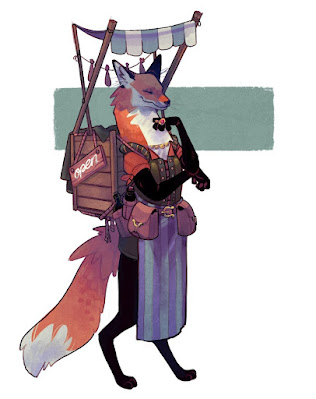
Fluff from a picture- Fox Merchant

At first glance, people may not trust a fox person as a merchant. That's not surprising, as nobody trusts fox people in the first place. But there's a big difference between stealing and encouraging people to spend their money in unwise ways; and foxes thrive exactly where that line is drawn. Let's talk about this one.

Art @SylviaJo (mildly NSFW)


The stall is a modified shipping crate modified for easy carrying. Lightweight woods were used for its construction, and naturally the whole thing is collapsible and portable. The awning is designed to keep the sun out of the seller's eyes, but also acts as a way to "stand out" from the rest of the crowd. The stripes of the awning also have special significance- to most casual observers and patrons, they would assume it is merely decorative, but it's actually code. White indicates a "clean" stall, without stolen goods, and "blue" indicates a fox whose goods are not of interest to other foxes. In other words, they're selling boring junk and overpriced novelties to tourists.

Typically, customers are expected to either approach the fox merchant from the front to ask about goods, or approach from behind. Selecting their items from the crate and dropping the appropriate coins in the bags strung up between the poles. To any human, this idea seems absurd- too easy for a cutpurse. This goes into their selling style- this fox may simply walk in front of anyone who they sense needs something- allowing them to make a quick purchase without breaking their stride. The fox merchant is good enough to keep up a conversation while patrons simply take and pay for what they wish from behind the seller- the fox can sense the shifting of weights and items in the box, they know what you've taken. This almost sixth sense of being able to anticipate a sale opportunity is what gives fox merchants- the perfectly legal ones- their competitive edge.

How much trust do these foxes put in their clients to serve them from behind? Of course- the fox is not a human. Their ears and sense of touch is more then fine enough to tell if someone is cheating. Each bag is soaked in a specific perfume overnight, meaning a sudden heavy coin dropping in will release a specific odor- no way to fake the noise. And this technique isn't just for the loose change. The fox's tail is also dipped in another scent- this one is for defense. Anyone who tries to steal or cheat the merchant, or a cutpurse who thinks they're fast enough to outfox a fox will get a quick brush from the tail. The thief will falsely assume they can get away before the fox can turn around, when in reality they've already coated their legs with a an easy to follow scent. Fox merchants are infamous for allowing thieves to run off and finishing their day at work, before casually leading the guards to the thief's hideout after sundown.

The pouches and bottles are there for the fox. Honest. Personal affects meant to be separate from what they're selling- they travel light. This fox merchant will have a bottle of water (they can't drink wine anyway) and a bottle of a common potion. Most commonly they carry a potion of charm or suggestibility to spike the drinks of anyone foolish enough they can get a fox more sauced up then themselves.

The clothes and apron are garb from local merchant's guilds. The fox, as a beastperson, has less need for clothes then humans and has less modesty in public, so borrowing a few official pieces of trader garb can make the fox look more official. Trader aprons are, of course, purely ceremonial. This profession is so far removed from actual physical labor that a butcher's smock or blacksmith apron is merely a symbol to be adopted.

The rings are highly rated status symbols. Fox people value rubies the highest of all precious stones, including diamonds- though diamonds are still more rare and expensive, the red ruby is the most romantic and infatuating stone. As with any merchant, rings act as both a symbol of ones wealth AND a potential store of future wealth- if you're really down on your luck, you can sell one to recoup your losses on a failed trading trip. Any fox would be remiss to do something like that to their ruby rings- unless they have a plan to get it back.

The necklace, still a symbol of wealth, is more personal. Foxes are not immune to their own reputations as tricksters and thieves, and they primarily project this quality of themselves into their hands and tails. Anything worn close to the body is more sacred. For this fox, four circles represent four children in a wonderful marriage to their loving partner. Maybe that's the reason this fox is on the straight and narrow.

Saturday, May 1, 2021

Scene from a Dream - The Dwarven Climb


You are one of many within the Dwarven army. Your patrol travels through the mountains, when you are stopped at a sheer cliff face climb. The patrol thins to a line as each and every dwarf must climb- the only strange thing is the silence atop the cliff.

As you climb the sheer cliff, you begin to see the carvings. They are names, these ones short and simple. These are memorial runes, for low born soldiers and humble servants. As you climb the cliff, they become more and more ornate, belonging to names from noble families. Your stomach twists into knots as you reach the top and climb over.


At the top of the cliff, you see it. It is a slab and a grave- for the King of the Dwarves. His great green axe sits atop it in memoriam. His long, royal name etched on stone. Your Noble King is dead, killed with his army, before the news of it could return to your unit. You feel the tears well up in your eyes, but must be silent. You weep silently, as all Dwarves must carry their own burdens alone; to cry out or warn those below would robe them the honor of suffering this loss each and all alone.

So, with the rest of your unit, you stand at the top as dwarf after dwarf crosses above, seeing the grave of their beloved monarch, noble and just, and each weeps silently. Every one of you will carry this burden alone, and by each alone, all together.

Thursday, December 3, 2020

Four level of Fantasy in Aesthetics (for Equipment/Items)

Originally, this was designed to be a Vagueposting article, but it's clear enough it doesn't need to be- though it is quite ranty. This is also a general listing of ideas that isn't necessarily tied into anything specific, obviously you could have mix-and-match elements of all of these levels, but it's organized in this fashion to make it a simple little d4 table, maybe if you're generating a fantasy setting with random rolls. This table is also specifically about the appearances of items, either in their description, materials, or actual artstyle as they appear in a video game or other visual medium. The actual power level or fantastical power of these items tends to be related but not always, and is mostly separate from this table.

Before we begin, I also want to stress that this is not an objective reviewing of these aesthetic “levels” as levels of quality or “realism”. I personally find value and enjoyment in ALL levels of this proposed grading scale; I see why some people might be bugged by things like overly decorative armor, huge weapons, bikini-mail and the like; to some it may detract from the experience. But on the other hand it also stresses the unreality of the world and plays into willing suspension of disbelief and can better communicate a growth or power scale- it totally depends on the story or kind of fantasy setting scale you want to set in your writing or play.


4 Levels of Fantastical Equipment Aesthetics
– Roll 1d4
[1] Mundania
Equipment is very much based on real world historical or inferred historical examples. Low tier or starting equipment may be rusted or broken, low quality stuff. If using a material scale it will typically be very simple- such as going from Bronze to Iron to Steel to “Better Steel” or like mythril and meteorite metal and what have you as fantasy material. High tier or “end game” equipment maybe extremely well crafted full plate mail or enchanted swords, but they will mostly just appear as real world swords would, though unusually shiny or perhaps mildly decorated with gems or gold in the most extreme of examples.

This tier of equipment-aesthetics doesn't necessarily mean equipment is less impactful or less powerful, though there tends to be a correlation between the two. For example, a sword like Excalibur can be extremely powerful or just “destined” for greatness in some way, even if it doesn't appear too much more fantastical then just a really high quality, somewhat ornate sword.

For this level of Fantastical Equipment-Aesthetics, I would put things like folklore/free domain art, The Witcher, Conan, and similar settings with “low fantasy” aesthetics, even though the actual magic or supernatural elements in the setting could be quite high. You could also tie in real world artifacts of special items or biblical fantasy stuff in a way; the Shroud of Turin for example is incredibly important and could be a very powerful relic in a modern fantasy esque world, but it's actual appearance is not fantastic or especially ornate. Obviously, any historical fantasy game or universe like Mount & Blade, Chivalry, Kingdom Come Deliverance and so forth all also belong in this tier. It'd also put Dark Souls at just a bit above this level; Dark Souls is well known for being really gritty and dark, but it still has certain fantasy aesthetics in the form of huge weapons, overly heavy armors, and some unreal designs for various equipment that the players can use or that enemy “humanoid” enemies can use- I'd put Dark Souls at something like a 1.5 to 1.7. Since we're on the subject, Bloodborne gets a much heavier rating, closer to a 3.5 or even a solid 4 on this list, not because of its grittiness but because of the unreality of all of its weapons, since those mechanical weapons are a pretty solid fit in that upper category.


[2]
Fantasy Sprinklings
In this fantasy world, most equipment, armor, and items tend to fall into the “close to real world practicality though too ornamental or unusual to be based on real historical models”. It is also common to see lower tier items or equipment be based on real historical examples, with only the end game or highest tier of magical or powerful weapons or armor be more fantastical or highly ornamental. Something like a bit of parade gear actually being the most powerful armor around, or a magic sword actually glowing, being on fire when drawn, pulsing with energy while otherwise being a mostly practical blade, etc.

This tier of fantasy equipment tends to imply worlds where the really powerful or crazy stuff is uncommon and hidden away, a bit towards the “low fantasy” spectrum, though obviously these aren't very defined terms we're using here. (Yes, we all already know the literary definition, nobody uses it because it's bad, I don't use it and will not mention it for the remainder of this essay.) Typically speaking most items may be of a grounded power level, as long as the world is not operating off of super video game or fantasy TTRPG logic- a steel sword is just a really good sword. But only the magical sword of truth which can slay dragons and is crazy indestructible and sharp and all that is allowed to have an unusual or unique appearance, and it tends to have a heavy power jump to fit. I'd also lump here a lot of fantasy stuff where most weapons/items are relatively grounded with only enchanted items having runes or special decorations that mark them as such; another good example might be Dungeon Crawl Stone Soup how you can tell if something is enchanted (but not necessarily cursed) by it being a “glowing” item as opposed to just a regular item.

As for common settings; I'd argue that Lord of the Rings, several TTRPG settings, and Harry Potter fit under this umbrella. Note- while Harry Potter is very much higher magic/higher fantasy then most of the fantasy settings we're discussing here, the actual appearances of the items and equipment is relatively grounded FOR THE STANDARDS of the setting. For example, I can't think of any examples of any Wizards carrying super crazy sparkling magic wands, faster broomsticks aren't really that much crazier then normal flying broomsticks, they're just more enchanted or made from a better “brand” of magical item makers, the “deluxe” model. Lord of the Rings is also relatively grounded in this sense, but many items are clearly fantastical (such as elven stuff, or the rings of power) which push it just out of the range of totally grounded “mundania” for me. Of course, Lord of the Rings (movies usually) is the poster child for “low fantasy grounded aesthetics that aren't trying TOO hard to be realistic”. Orc weapons/armor from the movies are also something that is pretty grounded in how it is presented while still being totally fantastical.

I'd also like to throw my hat in here for Zelda (pre-BotW) to be about this level. Most things aren't realistic by any means and have a specific aesthetic, but most things in that fantasy setting don't break or over complicate that aesthetic. (Also, the only reason I'm separating Breath of the Wild Zelda is because of the Sheikah technology and elemental weapons being highly separated from real world designs. I'd lump BotW Zelda in with the third category where the high fantasy artstyle of items is more prevalent. For referance, I'd put the Master Sword at a solid 1 to 2 on this list.)


[3]
High Fantasy
In this level, items and equipment may be made of wildly different materials or be heavily ornamented. This is also where you get things like constantly glowing or burning magic items, highly ornamented weapons, extremely oversized weapons, or just straight up fantastical weapons like chain whips or throwing cards/coins as actual viable tactics. Once against, it's not like these can't exist at lower levels, they just aren't as common.

This out of all the fantasy setting aesthetic levels is most likely to have a “tier list” of fantasy materials- starting at iron/steel for low level items, advancing towards magical crystals for weapons/armors, fantasy metals creating truly absurd gear, things that are more meant to look cool other then function, though because of stats or magical power they can still function even better then a more practical or grounded weapon. We also get a lot of stuff like bone, wood, or stone armor and weapons to match at around this level. Usually only the lower tier or starting weapons are in any way based on real world designs or looks, with fantastical items quickly making up the ranks or levels of power as opposed to typical metallic weapons or armors.

I would say a large number of High-Fantasy video games fit in this level; Elder Scrolls is a good example, though I'd maybe put it at a 2.8~ level for most of it. This level is pretty strongly fitting towards most MMORPGs, including World of Warcraft. I know a lot of people have a problem with the game's aesthetic in terms of realism- especially the pauldrons. I do think that WoW has some very strong unreality present in its items, but its stuff is still usually meant to appear as protective armor or damaging weapons. They are pretty strongly routed in the 3.5 to 4th level, with only starting gear resembling a more “realistic” artstyle. Once again, it's a gradient.

I'd also put Dota 2 and League of Legends around this level too- some characters are more grounded, but the art of many of the items you can buy in the game (if taken literally as being that's what weapon you'd use to fight with) could be thought of being much more fantastical then a more grounded setting- I'd put many of these items in the solid 3.5 to even level 4 for some of them; since some characters fight with literal rips in space and time, but others are just fighting with oversized swords and big golden armor.


[4]
Absurdia
This level, which I actually struggle to come up for good examples for, is for settings with almost no connection to reality. Most equipment or items have no similarities to real world items or equipment other then basic forms or general ideas. It's also perfectly possible for these to be presented in a grounded or mundane way, but the items themselves are very much made for and designed for the secondary world space.

In this level we see two vague categories. In one, we have a total rejection of real world materials at all; items may be made from crystals or glowing ores that have no connection to real world items at all. The second is where materials or basic colors/textures are not unusual; items may still be made of metals and the like, but they are simply twisted into forms that are impossible or downright unfitting- we can see examples like this in various JRPGs with characters using weapons like dolls or actual volley (blitz) balls as weapons.

As above; examples I'd like to give for this level are things like the Monster Hunter series (where even starting weapons are hugely oversized because you're fighting huge monsters, of course), and various JRPGs with their very imagination-driven character design. Cloud's Buster Sword and Squall's Gunblade are classically cited examples of unreal/fantastical items and weapons- this level could be considered the quintessential "anime" level and has quite a few Eastern influences, if that wasn't obvious.

As for more Western influences; Warhammer 40k also fits into this level with its super decorated, highly stylized models and artwork. Obviously things like cartoon-inspired settings like Banjo & Kazooie or Kid's Next Door (or 40k Orks) with everything being a jury-rigged contraption could also be roped into this level, if you count the unreality of how the item would actually function and the absurdity of the situation as being part of the “aesthetic” of the item which is otherwise made of relatively normal and understandable materials or in a normalized shape. While not an expert in the subject, I feel as though Warhammer 40k is a bit stronger towards this level then Warhammer fantasy, which for much of it I could put in the high 3 ish level scale, perhaps a 3.8 for fantasy, since we have a higher tolerance for that kind of the thing there as opposed to in science fiction, but that's just my opinion. Finally; truly absurd world-scapes like Wonderland are clearly at about this level of unreality, since that's their intention from the start.

Tuesday, October 20, 2020

The Coward


Ho! Hark my men, hear what our “lord” has said.
He calls after us, “coward!”, and still wishes me dead.
I'll tell him what for, give him my piece,
Upon that ridge, It will anger him at least.

Listen hear! Oh iron lord,
You shout at us, for we draw our cords,
Instead of meet you on battlefield, cleat and lead,
We both know that we'll simply wind up dead.

So yes, on your steed and with your band,
You have the advantage, Hoist your banner grand.
With torturous barb, and cruelest lance,
the peasants you trod cannot stop your advance.

But where do you think that gold was accrued?
Stolen from rightful owner, church, and orphanage stew!
Your army, your sword; stolen from honest man's plow.
So tell me, who do you think the coward is now?

So go on, iron lord, scream into the night.

Chase after us, us dogs, conjurers of fright.
But we know you'll have no rest under moon and sun,
As long as you chase us, for sleep you'll have none.

Watch your back, iron lord, your men only honor coin,

While we grow; all of ours freely join.
You'll jump at shadows, as long as you chase,
You're lord of rats and pigs and all traitorous race.

Goodbye iron lord, consider this the last.

You shan't hear my voice again, that time has past.
Next time you're alone, without a single friend,
Ask yourself; “Will that coward bring me my end?"

Thursday, June 11, 2020

DCSS - Orcs

This post is being written during the April shutdown due to the Corona virus. I often write blogposts in advance, but this time I thought I would actually straight up tell when it is being written for the very specific backstory I'm going to give you. Basically; during this shutdown everyone is just staying inside. And that means everyone is on the internet; some days it's pretty slow, or if the internet goes down where I live for whatever reason, then I don't have much to do since I can't even go to the gym.

But you know what I can play? Games that don't require internet access. And among those, I redownloaded Dungeon Crawl Stone Soup. I haven't played this game in years, and it's something I've always had a lot of nostalgia for. There's no sarcasm when I say that this game's massive dungeon crawling with many interlacing mechanics, loads of great races to play, tons of monsters and spells, and a bunch of other stuff is what helped get me into Dungeons and Dragons.

However, something very specific has stuck with me over the years with this game. And that's the Orcs.

Dungeon Crawl Stone Soup Orcs
The Orcs in this game are not exactly like any other orcs I've seen. They have this great look to them, but sadly they are just sprites! I love the way they look though. They have a more humanoid skin tone and appearance in general, but still look very “orc” ish. They have the classic tusks, glowing red eyes, and have an overall more “ogreish” appearance to them, but yet stay within a relatively human frame for size and shape. This in mind cements them as a more “baseline” race, despite them still being very orc ish. Then you have their ears, which are more bat like then pig like, but don't cross over too much with elf or humanoid ears. They also have a more rounded face, except the fat one (Blork), giving them less of that hulking brute look- it reminds me a bit of Lord of the Rings goblin/orcs/uruks in a way, though in Crawl they are explicitly bigger and stronger then humans.

As for the more lore aspects; I like how they have so many different designs and how they are a pretty constant threat throughout the game; their culture and general ideas behind them and the unique playstyle you get if you play an Orc who follows the Orc God Beough (only Orcs can follow this God), then you can recruit other Orcs to your side. It's pretty neat. Plus they are skilled with Fire magic, which is fitting, and get a bonus to the axes skill which makes sense, plus in general all the Orc mages and Priests you fight give them a more rounded depicition then just being a bunch of generic “warrior” dudes. They are very much a proud warrior race- but they can take it to the extreme which is where Beough comes in, making them racial supremacists. I even love their description;

An ugly subterranean race, orcs combine the worst features of humans, pigs and several other unpleasant creatures. They tend to run in packs or mobs, and delight in outbursts of insane violence.”
-From Crawlwiki

It gives me the distinct impression that this game's narrator is of an ancient, high elven race or perhaps an omnipotent 3rd person, lumping humans in with the world's fauna and as an 'unpleasant' creature at that. That may not be the way you're supposed to read into it, but I do. I love it. You can also see some of the inspirations from the animals there; I wonder if the author originally intended to have “humans, pigs, bats, and several other unpleasant creatures” included in there; their ears give me a distinct BAT look to them, plus them being a subterranean race in this game makes it fit.

I've already spent several blogposts talking about pig orcs, or more specifically, my P'orcs. As much as I like this homebrew take on the race, they don't really scream “generic fantasy orc”, which can be a bad thing sometimes. Any unique take on a race or thing in fantasy means extra learning time for your players or readers. Secondly, I have to be in the right exact mood for my P'orcs, where as the DCSS are much more easily seen as “Orc”ish in my eyes. I might switch to showing my Orcs in my games as more akin to the DCSS orcs, as opposed to my unique snowflake P'orcs.

But specifically, this blogpost is about their appearance, and more specifically their LACK of a appearance. As a game purely with sprites or originally ASCII graphics, the orcs lack definition. They only exist in description and as basic sprites; I would love to pick the brains of the original guy who did the spritework in this game's art to see what inspirations he was using for his Orcs, because they come from a very unique places. I've never seen any orcs exactly like this.

DCSS Orc Depictions
Here's a drawing I made of the Orcs from DCSS. In it, I experimented with different orc looks, and how to depict them in a slightly more detailed style then their sprite counterparts. The biggest issue though is the lack of a visible nose in the game. I then drew them with several nose types; including bat, pig, and humanoid noses. I drew different expressions since I'd have gotten bored with drawing them all the same way.

Art @spdhatsan
This is a piece of fanart of Blork the Orc, the fat unique Orc, about to get stabbed by an Octopode character (you can play an Octopus in DCSS, which is pretty cool). The artist here drew Blork with a much more “ogre-ish” look to him, though that could be just do to him being fat. Notice- a more humanoid nose was added here, since it isn't present in the sprite.

Art @here (artist name unknown?)
This picture here are several sketches of a felicid character (cat person, but not like a Khajiit. Just a straight up quadrupedal cat with magic and claw attacks). The top left frame seems to have a cat with Blork again, judging by the ears and weight, which once again gives it a more humanoid nose.

Finally, this last picture comes from the larger pixel art spreads that sometimes accompany the game when booting up. This creature here could be an orc, but I don't think so. It has downward facing fangs, red skin, small looking body next to that cauldron, and the armor and ears much more suggest a simple goblin or hobgoblin. Still, it's useful to see what its face might look like given their close relation to Orcs at least within most fantasy settings.

Conclusion
All in all, I really like the look and feel of orcs from DCSS, but it seems like creative freedom will allow whoever uses them to depict them however they wish. Bulbous, humanoid noses for those who want them to appear more uglier but more human, bat-like noses for those who may want to embrace the horror and deep-dwelling racial aspects, or a more pig-like nose for those who like their piggish orcs. I think “no Nose” might also be an option, but it seems weird and random; especially for a subterranean race to not rely on all of their senses in dark places. Perhaps they rely on their sense of taste and heat-sensing like reptiles instead, which is why I drew the silly reptile nose version in the last pictures. Truthfully, the pig to human nose ratio seems the most likely given the game's in-game description, but all of this was a fun exercise in drawing and imagination. Hope you enjoyed it.

Sunday, September 29, 2019

Dungeon Graffiti Generator

The Graffiti is... (Roll 1d8 per table)
Roll
...Written By
...Made with
...For
1
Goblinoid
Red Blood (Human)
Marking Territory
2
Troll
Colorful Blood (Monster)
Threats
3
Kobolds
Feces
Showcasing “Talent”
4
Gnolls
Scratches
Rite-of-Passage
5
Lizardmen
Acid Spit
Communication
6
Orcs
Slime
To Please Dark Gods
7
Bandits
Stolen Chalk
To Attract Mates
8
Something Else
Indescribable
Just for Fun

And the Graffiti depicts... (Roll 1d20)
[1] Fake exit or treasure trove, really leads to a trap or monster lair.
[2] The Great Green Devil Face from Tomb of Horrors.
[3] The Monster's face and claws or favorite weapon, terrifying the viewer.
[4] Some abstract design featuring right angles in a repeating pattern.
[5] Most sacred animal or monster to this culture, in the midst of flight or a battle.
[6] A great weapon, claw, or fist destroying a human castle in a single swipe.
[7] Nothing, it's just a few words written in a simple script set to the purpose.
[8] Runic Glyph. May have been copied from a Mage's book; too poorly drawn to activate.
[9] Lightning bolt from a cloud hitting a horse
[10] Several human stick-figures running from an imposing member of their species.
[11] Hint at the strongest monster in this dungeon
[12] Picture of poop with smell lines.
[13] Doodles of monsters, traps, weapons, armor, and treasure.
[14] A Dragon.
[15] The Monster's “Family Crest”
[16] Map of the surrounding 1d8+1 chambers. Traps marked with Xs. Very likely to be a trick, depending on the purpose of the graffiti.
[17] Name of the Monster's tribe, clan, or gang written down. Often written over the tags of a rival monster gang of a different species.
[18] Fake trap- such as little holes pretending to be arrows or fake spikes. Only looks convincing and in poor lighting, or if you were to run past it quickly. Comes with matching painted floor tiles.
[19] Primitive instructions on how to reset a nearby trap. Depending on the purpose of the drawing, it may be intentionally misleading and trigger the trap instead if followed exactly.
[20] Crude drawing of the monster raping an adventurer. If you've been here multiple times, it may look like one of the adventurers, at random. Equal chance of male or female adventurer.

Wednesday, September 12, 2018

Manse '18

This is a collection of basic game rules for the Manse Basic roleplaying system; a DIY style game. The goal of the game is to search dungeons for treasure, crawl the wilderness, and become a powerful character within a fantasy world. Danger lurks around every corner, but treasure awaits. This is the 200th post on this blog, and for the occasion, this is the most complete ruleset posted.

Character Creation
Roll your stats, pick your class and race, and choose equipment.

Stats- Roll 3d6 down the line for all 6 stats. Your result roll determines your stat modifier.
3-4 = -2
5-8 = -1
9-12 = 0
13-16 = +1
17-18 = +2

[Strength] Add modifier melee to-hit rolls and for carrying capacity in load units.
[Dexterity] Add modifiers to ranged to hit, bonus AC, and stealth rolls.
[Constitution] Each modifier is +/-5% max HP rounded to the nearest whole number.
[Intelligence] Add modifiers to known languages and magic rolls.
[Wisdom] Add modifier to healing rolls and all saving throw rolls.
[Charisma] Add modifier to reaction rolls and starting coins.

Classes
Pick your classes based on your talents and what your party needs. There is no multiclassing and classes progress linearly; it's about what your character does that defines them.

Fighter
HD- d10
Max AC- 16
Saves- Every odd level, +1 to combat saves. Every even level, +1 to all saves.

You are the strong, powerful, determined and skilled. While others fear to face the monsters, you stand tall against them. You represent the spirit of the warrior in all its forms. Your fighting style may be advanced, brutal, practical, or flashy- all of you be Fighters. Your class is the only one capable of wielding the most powerful magic weapons and armors and unlocking the most powerful of the secret blade arts. You're also physically tough and hard to kill.

Because of your HD- you almost always go first in combat and have a 50% chance to get advantage on your attack, as well as a 10% chance to get a second attack. This is an inherent property of the combat system, and grants you quite an extreme advantage against monsters at low levels. Your minimum starting HP is also 6 instead of 2 like most classes. You also ignore the combat save penalties to wearing heavy metallic armors regardless of your level.

Every Even level, you get +1 to hit on attack rolls with all weapons.

At levels 3, 6, 9, and 10 you get +1 damage on a successful hit.

At level 5, you get +1 maximum AC. At level 7, you get +1 Leadership, which among other things gives all your hirelings +1 morale/loyalty.

At 10th level, you become a Champion. You are capable of starting your own fort- as long as you can get the money together, people will come to live under your protection against the monsters and bandits. You could buy the fort as you level and slowly build it, or reclaim ruins to use as a home base, but you don't attract anyone else or are not seen as a “true” lord of the land until you reach 10th level, even if the fort was finished before this. You also attract 40 Militia men. These fight as regular, 1 HD men divided into 4 squads. Four of these men are Captains; one for each squad and count as a 1st level Fighter for their hit points and other abilities, and could be made into hirelings or trained to become even stronger or be taught some of your blade arts.

Additionally; you gain the Mighty Cleave ability. When fighting an enemy force of 1 HD opponents, you don't roll to hit. Instead, roll damage and you slay that many of them in one round.

Rogue
HD- d8
Max AC- 14
Saves- At first level, +1 to all. Every odd level, +1 to hazard saves. Every even level, +1 to all saves.

You are the sneaky thief, the deadly Assassin, and the swashbuckling folk hero. Beyond your stealth, and ability to attack from ambush, you are also decent in a fight and are skilled with devices and skillful when it comes to exploration. Their are some gadgets, poisons, and magic instruments that only your skilled hands can ply. You are adept at avoiding danger, and get +1 to all saves at first level.

Rogues are very skilled with mechanical devices and tasks requiring skill and coordination. As long as you are using an appropriate tool, such as an iron prybar, lockpicks, climbing hooks, sandbags, and so on you can add your Rogue level to your skill checks and rolls called by the DM during rulings.

At levels 1, 3, 6, 9, and 10 you get +1 to your Stealth rolls. You can also add this bonus to both the to hit AND damage of your sneak attacks.

At levels 4, 8, and 10 get +1 to hit with all weapons.

At 10th level, you become either a Folk Hero or a Master Thief, depending on how you used your abilities and made your fortunes. If you stole from dungeons, stole from nobles to give to the poor, and sought fame and glory as well as money then you're more of a Folk Hero, but if you mostly stole for your own personal gain, used your talents as an assassin or spy, as well as kept a low profile, you're more of a Master Thief.

The Folk Hero can become the leader of a merchant caravan or fleet, or the master of a guildhall. If you're a Master Thief, you can instead gather the scum of society around you as your own personal, secret Thieves guild. Both possibilities can be taken in combination with becoming the mayor or leader of your own settlement, which will require protection from outside threats.

Additionally; you gain the ability Escape Artist. Make your way out of bindings, holding cells, and seemingly unwinnable situations once per adventure. You could also use this ability along with a smoke bomb or distraction to reenter stealth right under your pursuers noses.

Magician
HD- d6
Max AC- 12
Saves- Every odd level, +1 to magic saves. Every even level, +1 to all saves.

You are the mystical and curious of the mortal races. You have studied and can cast magical spells better then anyone else. You are a magic user- but also learned and have some useful scholarly knowledge. You can attempt to learn something about magic items as well as monster clues to help identify them and potentially learn any benefits or dangers from them. Your extrasensory abilities are more developed then most; you have an ability to sense danger. If you meditate for an entire exploration turn while sensing a suspected thing; you can sense if it is dangerous or has a trap. You can only do this if the depth or height you are within a dungeon is equal to or less then your caster level.

You treat your level as one higher for commanding/turning defeated spirits and undead. At level 5, this doubles, and you now treat your level as two higher for this purpose.

Your main ability is to cast spells. You get one spell slot per level, with levels 3, 6, and 10 granting newer spell slots of higher levels. You always fill in spell slots from the lowest open slot upwards; and ascend through the magic circles in a pyramid like progression. See the graph for an easy visualization of this method. Your spell slots can be expended to cast any spell you know of an appropriate level or less; but spell slots only return at the end of an adventure when you have time to restore your magical energies and study your tomes once again; usually this means returning to town or a base. You roll two starting spells; then must find or purchase all of the others in order to grow your grimoire.

At 10th level, you become a Wizard. You can build yourself a magician's tower or manse in an area filled with magical energy or phenomenon. Most Wizards do this in far away places and live as hermits, due to the fact you will receive 1d4 annoying petitioners each season asking you to solve their problems and grant their wishes with your awesome magical powers. What you do with them is your choice. You will also receive a 1st level apprentice Sage seeking guidance and training.

You gain no additional special powers or properties at 10th level, beyond the fact that you can now cast 4th level spells; among the most powerful and devastating magic around. Sorcerers rank and organize themselves along with the highest level spell they can cast; Magicians of the 1st circle are little more then apprentices where as a Wizard of the 4th Circle like yourself is considered a master. There are rumored to be Archmages of the 5th or even 6th Circle out there, somewhere.

Sage Spells Table
Level
1st Circle
2nd Circle
3rd Circle
4th Circle
1
1


2
2


3
2
1


4
3
1


5
3
2


6
3
2
1

7
4
2
1

8
4
3
1

9
4
3
2

10
4
3
2
1

Races
Races are determined by player & DM consensus. Once you determine your race, any special qualities you ask to have will be paired with a negative drawback of equal value. For instance, a dog humanoid with a minor bonus to use their sharp nose to help search for items and treasure, but will be susceptible to fleas as a minor drawback.

Other players may copy or play as the same race that another player has; but some races may have stat modifier requisites to play as them. If a player decides to play as a Oni and has +2 Strength, and it is decided that Oni are all very strong, everyone else who wants to play as an Oni will have to have at least +2 Strength in order to play as them too.

Rules
Hit Points- Roll your class die at first level and every time you level up after, and add that much to your hit points. Your minimum HP is 2. If you ever drop to 0 hit points or less, you die.

Combat- Roll you class HD at the start of each round. This is your initiative, with bigger numbers going first. If you roll at least 6, you get advantage on your attack. If you rolled a 10, which is only possible for Fighters, you get two attacks (with advantage) this round.

When you attack, roll d20 + to hit bonus vs enemy AC. On a hit, roll your weapon's damage. Each weapon has a damage die- if the weapon's damage die exceeds your class's HD, then you must use your class HD for the damage roll instead. Your class HD limits your damage potential.

Spells in combat take one round to cast; if you are damaged while channeling a spell that is cast or controlled over multiple rounds, make a save or the spell fizzles. Distractions like flashes of light or loud noises might give you an easy save, but failure still loses your spell.

During combat; players can attempt any sort of reasonable action such as grapples, “called shots”, using improvised weapons or tactics, the environment, and so on to get an advantage. Doing so may call for a roll or sacrifice of your attack. You can always try these actions regardless of your class; be creative in what you do.

Inventory- Items are abstracted into units of Load. Load is roughly equal to the size and weight of the item; a dagger would be 1 load and a sword 2 load, for example. Bags of 100 coins are 1 load. Very small objects may not count towards encumbrance. You have an encumbrance of 8 + Strength modifier; and each time over you exceed this number you get slower and more likely to run into monsters.

(Optional) Stow is an optional rule that limits the number of items you can access at any time in combat. The rules are found here. If you use Stow, grant Rogues +1 to Stow at levels 1, 2, 4, 8, and 10. This allows you to have more items and equipment on hand during combat.

Skill Checks- Whenever you wish to do something that requires a lot of skill or coordination, roll a d20. Rogues get a bonus to do things related to their class, like climbing, lockpicking, or playing music to lull a beast to sleep. The difficulty of the task determines how high you have to roll to succeed.

Saving Throws- Whenever you are forced to defy danger, roll a d20 and add relevant class or stat modifiers. Making the save means you have a reduced negative effect or negate it altogether. Different classes have different defenses against different threats.

Progression- Coins and treasure spent grants XP equal to the amount spent. Wasting money on frivolous things may grant +10% bonus XP. To advance from first level to second level requires 100 coins spent, and it doubles each time. To reach 2nd level is 100 coins, to reach 3rd level is 200 coins, to reach 4th level is 400 coins, 5th level is 800 coins, and so on.

Equipment
Weapons deal damage based on their size and how powerful they are. Daggers, blackjacks, slings, darts, and similar deal 1d4 damage. Swords, arrows, spears, maces and “standard” weapons deal 1d6 damage. Big weapons, like bastard swords, poleaxes, huge axes and so on deal 1d8 damage. You can use any weapon regardless of your class, but your maximum damage is limited to your class HD or less. Magical weapons have an Ego score- which means the more powerful they are, the more they try to manipulate and control the user. Only powerful Warriors- as in Fighters and to a lesser extent Rogues, can control these and bind them to their will.

Weapons are differentiated not just by size but also by the fiction of the game world. You could use a sword to cut a rope, but not a hammer. Skeletons take no damage from arrows or spears, etc.

If you use a weapon in both hands and swing with all your might; on a hit you get to add your Strength modifier to damage; but cannot use your other hand to cast spells, use a shield, grab a potion, etc. If you have a negative Strength modifier; you can do this to ignore your negative to your to-hit roll, but lose AC equal to your negative strength as you put yourself open. You can also duel wield. If you do, roll both damage die on a hit and take the higher of the both. If they match, deal damage equal to the value on one die + Dexterity modifier, positive or negative.

Armor & Shields you AC. Armors made from material like padded cloth, leather, bone, and other more supernatural materials are considered light armor where as armor made from metal or stone is considered heavy armor. Heavy armor has much higher AC per piece, but has higher load towards your encumbrance AND you get -1 to combat saves per AC bonus gained from heavy armor unless you are a Fighter. Shields always grant +1 AC, unless you're using a shield as big as your character, in which case it's considered a tower shield and grants +2 AC. Similar to magic weapons; magic armors may have an ego score and refuse to serve weak men.

Magically inclined character also have their own tools as well. If you cast a spell while wielding a staff or rod, you get +1 to the spell's damage. If you cast a spell while wielding a wand, enemies get -2 to their saving throw vs your spells. If you cast a spell while wielding a magic crystal ball, or by drawing runes on the ground with chalk, you can extend the duration of the spell by +1 round if it lasts rounds, up to a turn if it lasts a few minutes, and +1 turn if it lasts multiple turns, even +1 days if the spell lasts multiple days, but this is the limit of a normal orb's power.

Tonics are special versions of potions. Tonics are magical potions that last only 24 hours after they are brewed- if they are not drunk or used by then, they become useless. Tonics purchased in town lose their magic after this first day, but they can be made on demand and are much cheaper then potions with a longer shelf life. You can brew tonics yourself by finding and brewing your own ingredients you find.

Shopping
Starting characters begin with 300 + (Charisma modifier x150) coins to spend before their first dungeon trip. This money does not count towards XP and should be spent to give you the tools and equipment you will need in the dungeon. Characters with -2 Charisma start with rags and a single improvised weapon, such as a sharp stake or frying pan (1d2 damage).

Weapons
Name
Damage
Load
Cost
Description
Dagger
1d4
1 per 3
20
Metal, straight. Useful for cutting.
Club
1d4
1
5
Made of wood, simple. Could be burned.
Staff
1d4
1
10
Long, wooden. Spell cast with it get +1 damage.
Spear
1d6
2
25
If head removed; could be used as a long pole.
Sword
1d6
2
150
Competent craftsmanship.
Mace
1d6
2
100
Very durable.
Axe
1d6
2
80
Good at cutting wood, cutting of limbs.
Battleaxe
1d8
3
250
Huge, unrealistic, two handed. Wooden haft.
Greatsword
1d8
3
450
Huge, two handed. Good craftsmanship.
Javelin
1d4/1d6
2 p. 3
10
Sold separately, deals only 1d4 melee.
Bow
1d6
2
10
Ranged weapon, fires arrows.
Crossbow
1d8
3
90
Ranged weapon, fires bolts. Must reload.
Sling Bullets
(1d4)
1 p. 20
2 for 1
The sling is free, bullets come in Bag of 20
Arrows
1d6
2 p. 20
2 each
Cost is per arrow. Held in Quivers of 20
Caltrops
1
1
60
Scattered; deals 1 damage when moved through

Armors
Name
AC
Load
Cost
Description
Shield
1
1
100
Made of wood, painted. Smallshield.
Tower Shield
2
3
200
Fabric or hide, as tall as you.
Gambeson
1
1
150
Padded cloth, worn on the chest.
Iron Scale
2
2
250
(Heavy) Worn on chest.
Chainmail
3
4
500
(Heavy) Worn on chest.
Chain Cowl
1
2
150
(Heavy) Worn on head.
Iron Helmet
2
3
350
(Heavy) Worn on head. Horns optional.

Magic
Name
Load
Cost
Description
Healing Tonic
1
50
Restores 1d6 hit points. All tonics expire after 1 day.
Curing Tonic
1
50
Restores 1d6 stat damage; fights off disease 1d6 days
Antidote Tonic
1
20
Drink after poisoned; prevents 2d6 of that damage
Magic Tonic
1
150
Restores a 1st level spell slot or equivalent power
Wand
1
10
Carved, Wooden. Your spells get +2 save difficulty.
Orb
1
100
Polished. Your spells increase duration by +1 unit.
Quills + Parchment
1
15
Take notes, 3 pages of parchment.
Holy Pentagram
1
200
Made of pale gold. Commands defeated spirits.

Supplies
Name
Load
Cost
Description
Ration (meal)
1 p. 3
2 per 3
Enough for one meal. Humans = 3 meals a day
Torch
1 p. 3
5
Burns out about once per hour.
Lamp
2
40
Burns lamp oil. Holds 2 units.
Oil Flask
1 p. 2
5
One unit of oil each- 1 unit lasts 1d2 hours.
Pole
2
5
Long wooden pole
Iron Prybar
2
10
Used to force things open. 1d2 improvised weapon
Lockpick
1 p. 5
15
Picks locks quietly. Breaks on a failed roll.
Other Tools
1
5
Chisel, Mallet, Chalk, Shovel, Marbles, etc.

Starting Spells
Roll a d10 to determine your Magicians's starting spell. All spells here are first circle spells; all spells beyond this will require research, finding them in a dungeon, or purchasing training from other magic users.
  1. Conveyance of Supply & Spoils
  2. Seeking Projectile of the Magus
  3. Inclement Manifestation
  4. Glower of Potent Foulness
  5. Blocked Passage of Obfuscation
  6. Sorcery of Extreme Weakness
  7. Protection from Hexes & Curses
  8. Pathway of Prophecy
  9. Fleeting Binding of Wounds
  10. Calling of Stellar Lights
Spell Descriptions
[1] Conveyance of Supply & Spoils - 1st Circle
This spell conjures forth a creature, known as an Astral Conveyor. It appears as a squat creature, similar to a tortoise, with a metallic shell. It has no head and four bright-blue tentacle appendages that exit the holes, which is uses to shuffle around on the ground. When attacked, the creature curls up and is treated as AC 20 from all attacks. It has 1 HD and cannot attack. It lasts for 18 exploration turns. If the creature is killed, everything it is carrying gets spilled out as it disappears.

The shell of the creature is shaped in such a way as to have a treasure chest fused to the top of it. The chest is unlocked, but has metal loops to which a lock could be attached. The treasure chest can hold up to 8 load worth of items, but only things that could fit within the chest. Once the duration of the spell ends, any lock placed on the creature automatically opens and it spits out all of the items in the chest, before disintegrating back to the Astral Plane. If the chest is somehow forced shut, or the creature is killed in an unusual way, everything in the chest may simply phase out of existence and go into the Astral plane as a lost object.

[2] Seeking Projectile of the Magus - 1st Circle
Fires forth bolts, beams, or rays of magical energy that deal 1d6 damage. The target does not get a save, nor can this spell miss. You can fire this spell at any target within a stones throw as range. Highly trained fighters or people with magical protection may be able to deflect or lessen the damage of this spell through their advanced techniques.

This spell is totally unique to every mage that practices it- make sure to describe what your version of the spell looks like. How spectacular the spell looks may be tied to your character's level, but it can never cause another caster to lose concentration nor can it have extra effects (such as blinding from a bright flash of light.) The appearance of the spell is purely for flavor.

[3] Inclement Manifestation - 1st Circle
Once this spell is cast, a 40ft area designated by the caster becomes supernaturally stormy. Cold mists, hard winds, mud, and so on harries anyone trying to move or fight through this area. Slows down anyone traveling through it to a crawl; they treat their initiative die as one smaller OR have half movement unless they have appropriate gear or supernatural abilities.

The spell lasts a few minutes; long enough to cover any combat or chase, but dissipates before an exploration turn. Firing into or out of the manifestation with ranged weapons is hard, and anyone attempting to do so gets -2 to hit with arrows or thrown weapons.

[4] Glower of Potent Foulness - 1st Circle
When cast, shrouds the magic user or the area they are in with a pale green light that causes fear and panic in their foes. Enemies who see this light before combat will be forced to roll a morale check. If you are in combat, the glow makes enemies you are facing treat their morale as -2 for as long for the next 3 rounds.

This pale glowing light is often used by magic users while performing their dark magics to keep away suspicious and curious troublemakers from their lairs or laboratories; magic of higher tiers creates light like this all on its own, and this spell replicates that. It works best on the superstitious.

[5] Blocked Passage of Obfuscation - 1st Circle
Spell creates a wall of blackness. Closes up a gap 10 ft across or less. The gap is closed by solid, supernatural darkness and lasts by 1d4 exploration turns. The gap could only be destroyed by a very bright light, strong magic, or superior strength, but is impassable to most foes. You cannot see or hear through this gap with normal eyes and ears.

This blockage is used by magic users to either trap things behind them or to make easy escapes. Denizens who live in the dungeon will see the black wall as something an intruder put up, as they will be used to the layout of their dungeon. Monsters with darkvision may also be able to dimly see through the blockage, their dark vision giving some penetration.

[6] Sorcery of Extreme Weakness - 1st Circle
Hex that targets one enemy in the magic user's vision. This spell lowers the target's HD or level by 1 temporarily. Casting this spell multiple times “stacks” the draining effect. If the target goes down to 0 HD or less, they go limp and become useless and powerless until their strength returns. The target's strength returns at a rate of 1 per exploration turn.

Because many monster abilities, spells, and resistances rely on the creature's HD, this spell can make a monster weak enough to be vulnerable to your other spells, special weapons and blade arts, and so on. This spell doesn't deal direct damage, but does lower enemy HP by a hit die, and if this drops the enemy to 0 HP or less then they will remain standing but they are clearly one hit away from death.

[7] Protection from Hexes & Curses - 1st Circle
This enchantment creates a shield around the target that allows them to succeed the next saving throw against a spell OR absorb a single damage die from a magic attack, regardless of its size. If a spell would do 2 damage die, such as 2d6, then this spell lowers it to 1d6 instead, etc. Does not work against any spell that has a “hard” saving throw.

Against spells with effects over multiple rounds or turns, this ability becomes significantly less useful as it will only protect against the first roll. Targets under the effect of this protection have a white shine on their body if you look at them through wizard vision or some other extrasensory ability. Against nonspecific curses, this spell will also block it.

[8] Pathway of Prophecy - 1st Circle
This spell illuminates a path, either on the ground or on nearby objects like trees, walls, pillars, etc. that leads you to a common destination. The destination you dictate must be either a place your character has already been to, or would be commonly seen or known by anyone with a quick walk through of this floor. For example, the stairs up or stairs down, the water pit, the orc's camp, the dragon's lair, etc. These places would have to be clearly obvious to anyone walking around the dungeon without impediment. The path would stop short at locked doors or would not appear at all if the location specified was hidden or otherwise blocked off.

If the location of the spell was known before the spell was cast, and then something blocked it, the path would lead to the blockage and go there. If you were trapped in a dungeon with shifting walls, for example, then the path would go all the way to the wall that had shifted in your path. If the location was already behind a hidden wall however, then it would not work. The pathway lasts for 3 exploration turns on its own, or until the path is followed to its end or suddenly stops due to a blockade. Because the pathway glows and is obvious; monsters can tell when you're coming or can follow you along behind your path, making this spell dangerous and not stealthy at all to use.

[9] Fleeting Binding of Wounds - 1st Circle
This spell conjures bright, colorful bandages of the caster's favorite color around the targets wounds. The bandages don't restrict movement at all, but help staunch bleeding and count as granting +1d6 temporary hit points, up to an unable to exceed the target's maximum hit points. The bandages are also mystical in that they do things like straighten broken parts, or compress swollen areas when wrapped around the target, a “one size fits all” solution to injury.

The bandages automatically unravel after an hour, or 6 exploration turns. The temporary hit points disappear with them, but temporary hit points are always deducted before normal hit points when taking damage from combat or spells. If in town by the time these wear off, there is little danger, as the bandages will simply be removed and replaced with clean bandages.

[10] Calling of Stellar Lights - 1st Circle
The caster can bring forth supernatural light from the stars. All light conjured by this spell is a bit dim, colorless but still useful light similar to a bright moonlit night. It's concentrated starlight, and as such has no special effects of monsters or vampires. When cast, the intensity of this spell is directed by the caster, and comes in three general levels.

The spell can be focused to a narrow pin prick of light. The pin of light acts like a beam spell attack, which require a to hit roll to hit an opponent and only deals 1 damage on a hit. However, the focused beam can light dry things on fire, such as dry wood or thin cloth fabrics.

The spell can also be cast as a flare which shoots itself from the caster's fingers, creating a bright light that illuminates a large area. The flare, if shot into the sky, looks like a very bright star close to the ground and will attract attention. If fired down a hallway or passage, may scare a group of monsters thinking it is a more serious attack or illuminate the depths of a hole before you jump down, etc. Flares are bright and large enough to illuminate a large area, such as an entire forest clearing, but only last for 3 combat rounds.

Finally, the spell can also be used as a light spell; creating the colorless light around the caster and following them akin to the light of a torch or lantern, but without the yellowish tint or open flame. The light spell lasts for one exploration turn.